Abstract
In Task and motion planning (TAMP), symbolic search is combined with continuous geometric planning. A task planner finds an action sequence while a motion planner checks its feasibility and plans the corresponding sequence of motions. However, due to the high combinatorial complexity of discrete search, the number of calls to the geometric planner can be very large. Previous works [1] [2] leverage learning methods to efficiently predict the feasibility of actions, much like humans do, on tabletop scenarios. This way, the time spent on motion planning can be greatly reduced. In this work, we generalize these methods to 3D environments, thus covering the whole workspace of the robot. We propose an efficient method for 3D scene representation, along with a deep neural network capable of predicting the probability of feasibility of an action. We develop a simple TAMP algorithm that integrates the trained classifier, and demonstrate the performance gain of using our approach on multiple problem domains. On complex problems, our method can reduce the time spent on geometric planning by up to 90%.
Proposed Model
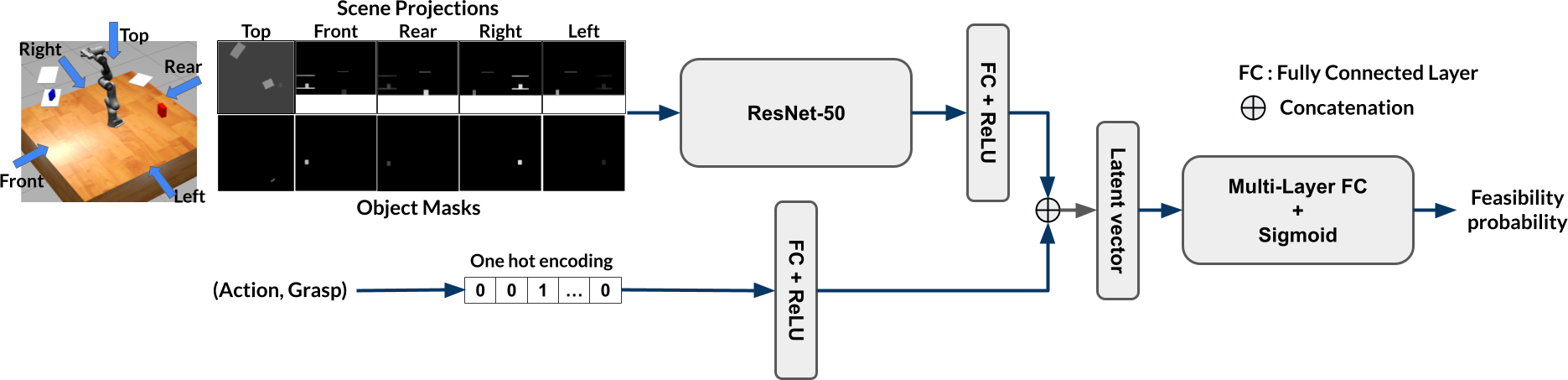
A visualization of the proposed neural network architecture used for action feasibility prediction.
Benchmarks
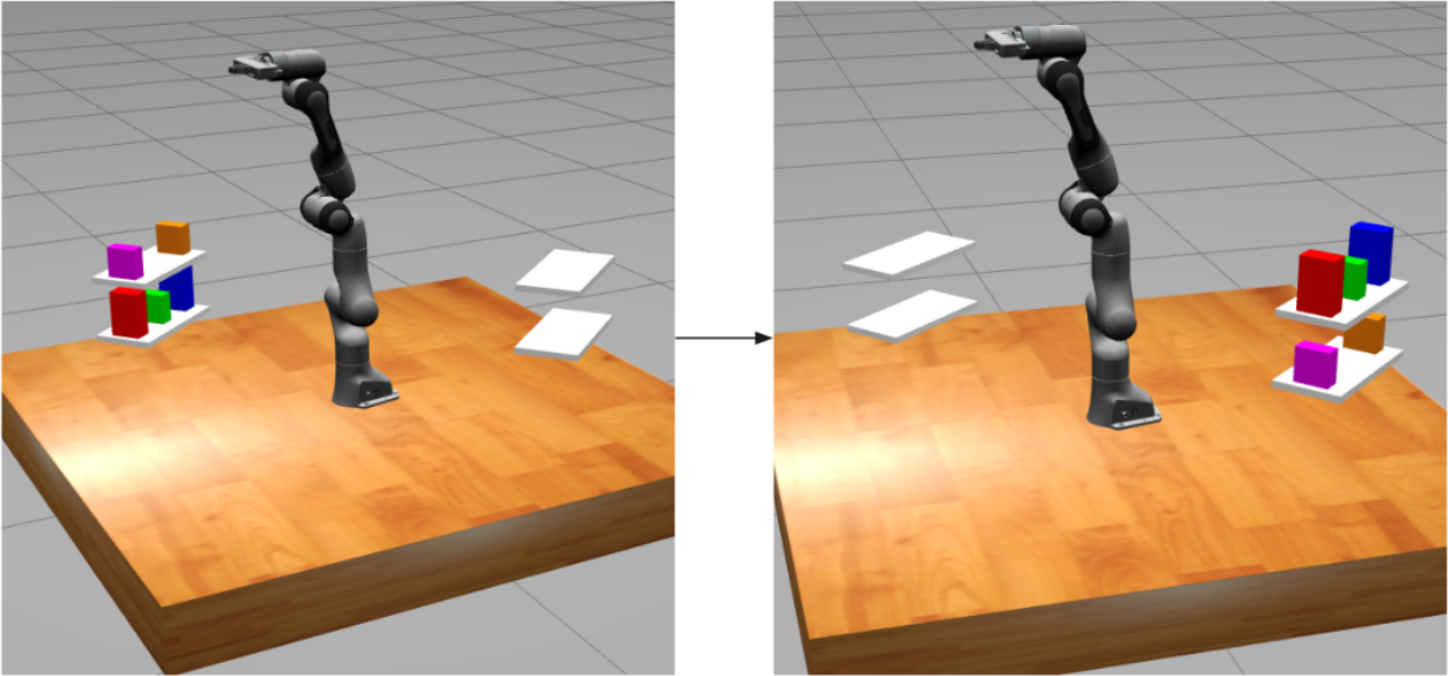
Reorder problem: Objects initially placed on a two-shelf cupboard must be moved to another cupboard in a different order, testing the algorithm's ability to handle grasp choices and infeasible placements under shelves.
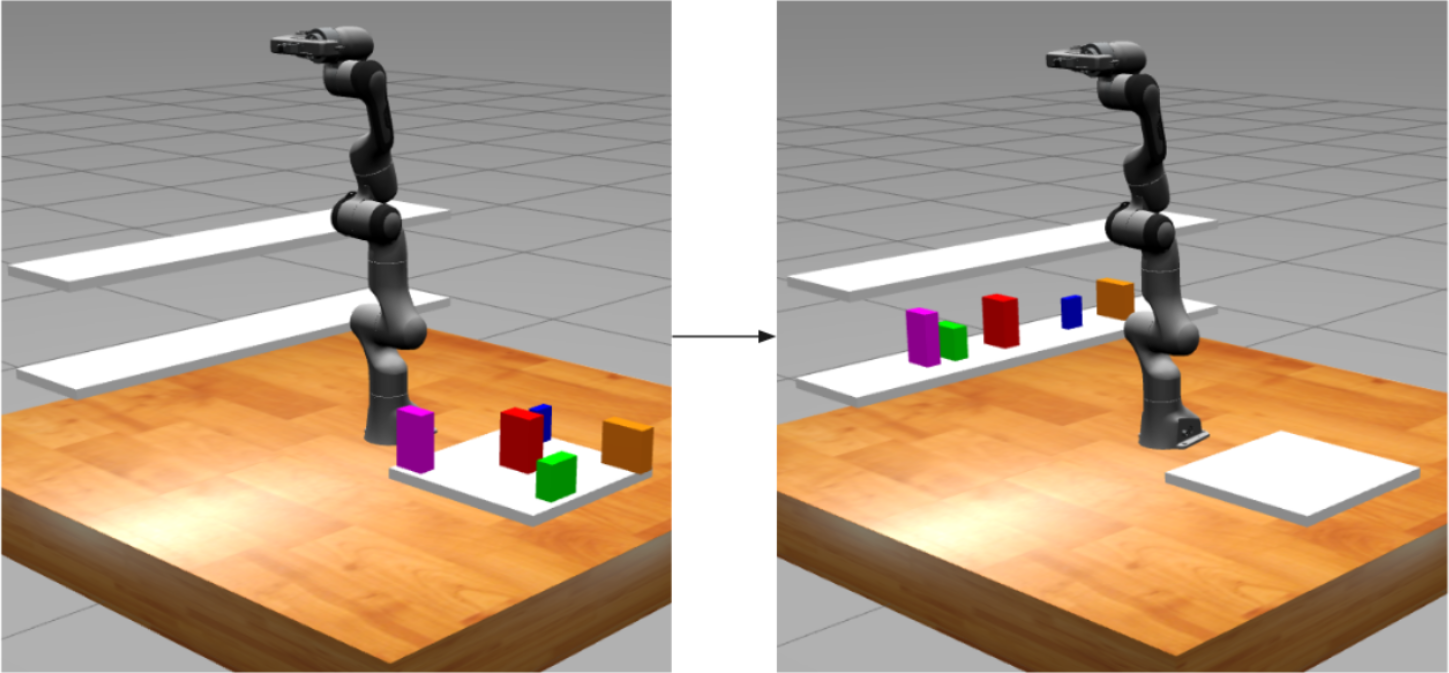
Unpack problem: Objects initially placed on a tray-like surface must be unpacked and ordered into a cupboard. The challenge lies in selecting feasible grasps due to the proximity of objects and the restricted goal placements under a shelf, which disallow top grasps.
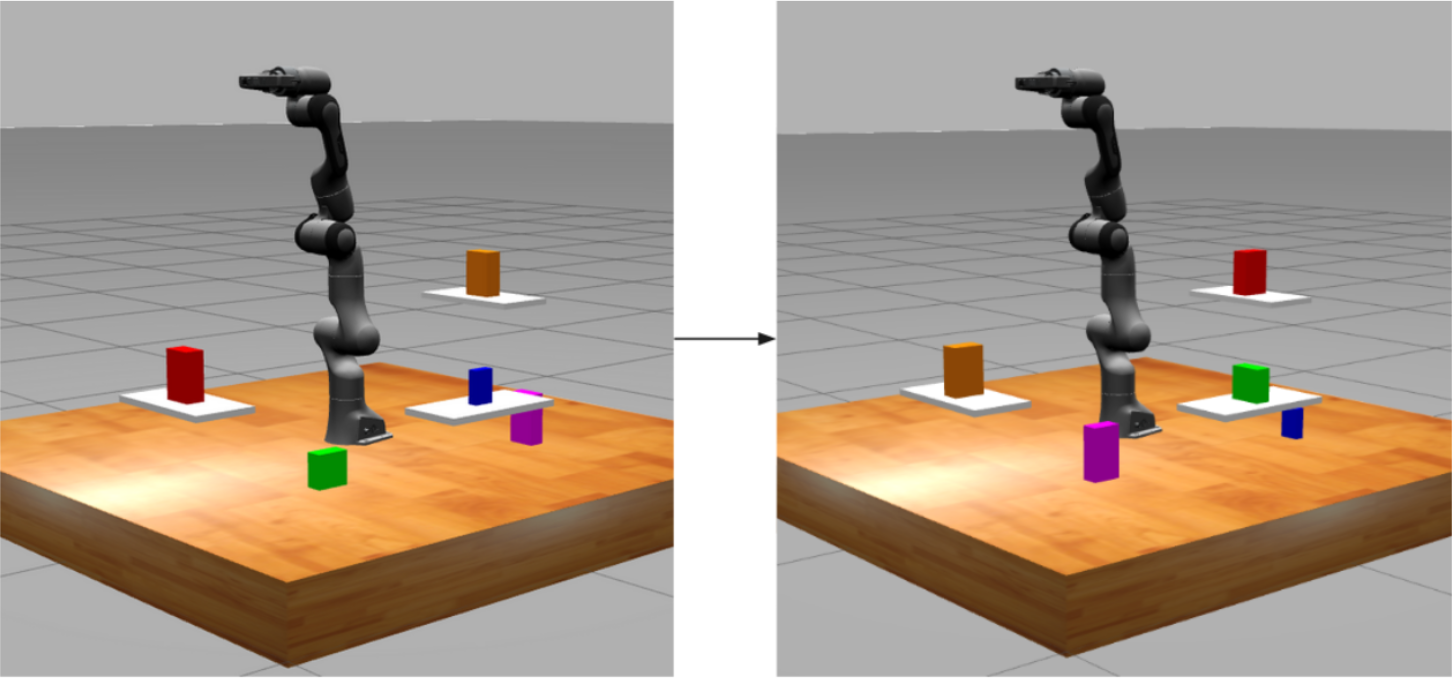
Swap problem: A set of objects are initially placed either on the table or on higher support surfaces, and the goal is to swap their poses. The challenge arises from the fact that the goal poses of objects are already occupied, requiring the use of intermediary placements to achieve the desired configuration.
Results
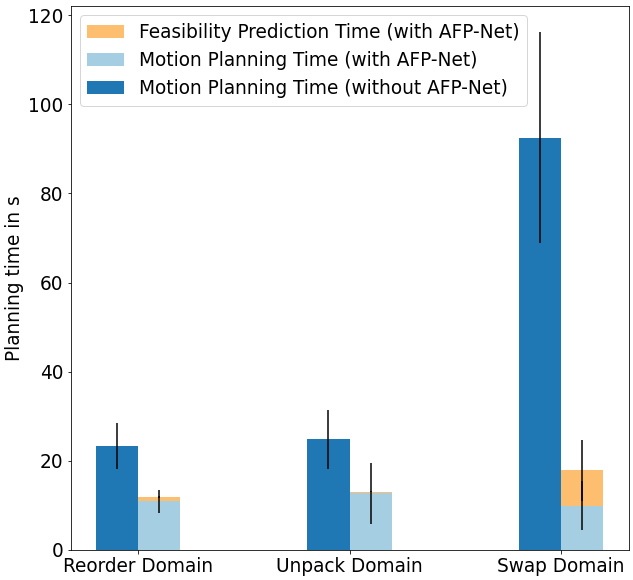
Detailed planning time of our algorithm on the 2-object version of the problems with and without using AFP-Net, averaged over 10 runs.
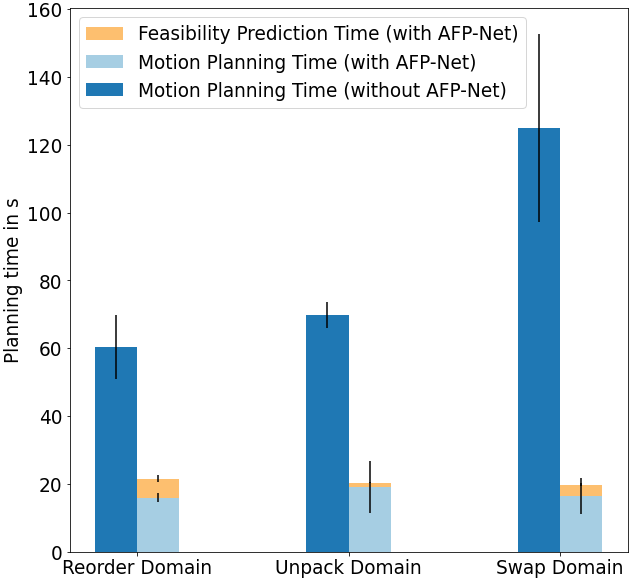
Detailed planning time of our algorithm on the 5-object version of the problems with and without using AFP-Net, averaged over 10 runs.

Comparison of the performance of the TAMP algorithm with and without using AFP-Net on the 5-object version of the three problem domains. Results are averaged over 10 runs.
Visualizations
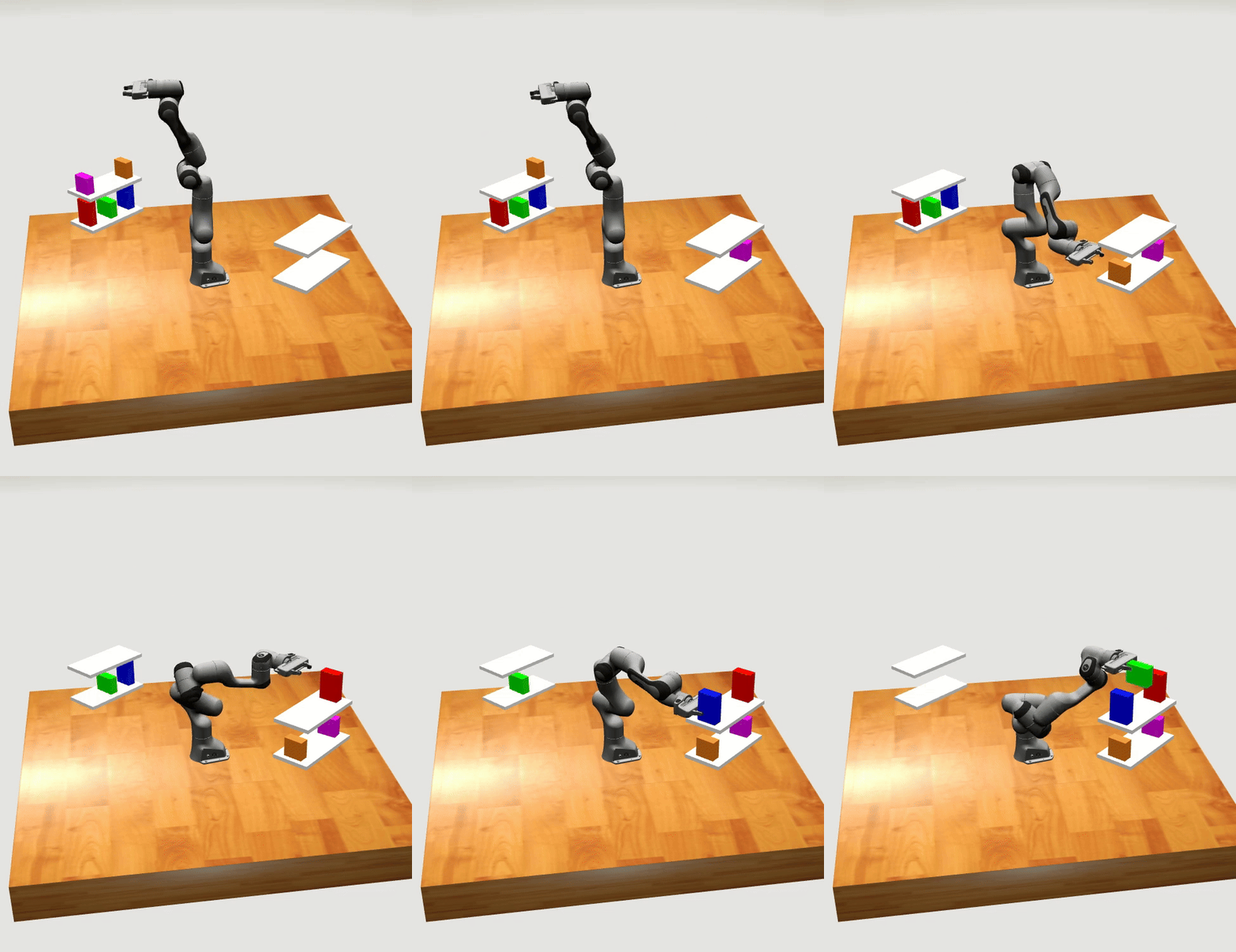
Execution of the reordering task with 5 objects.
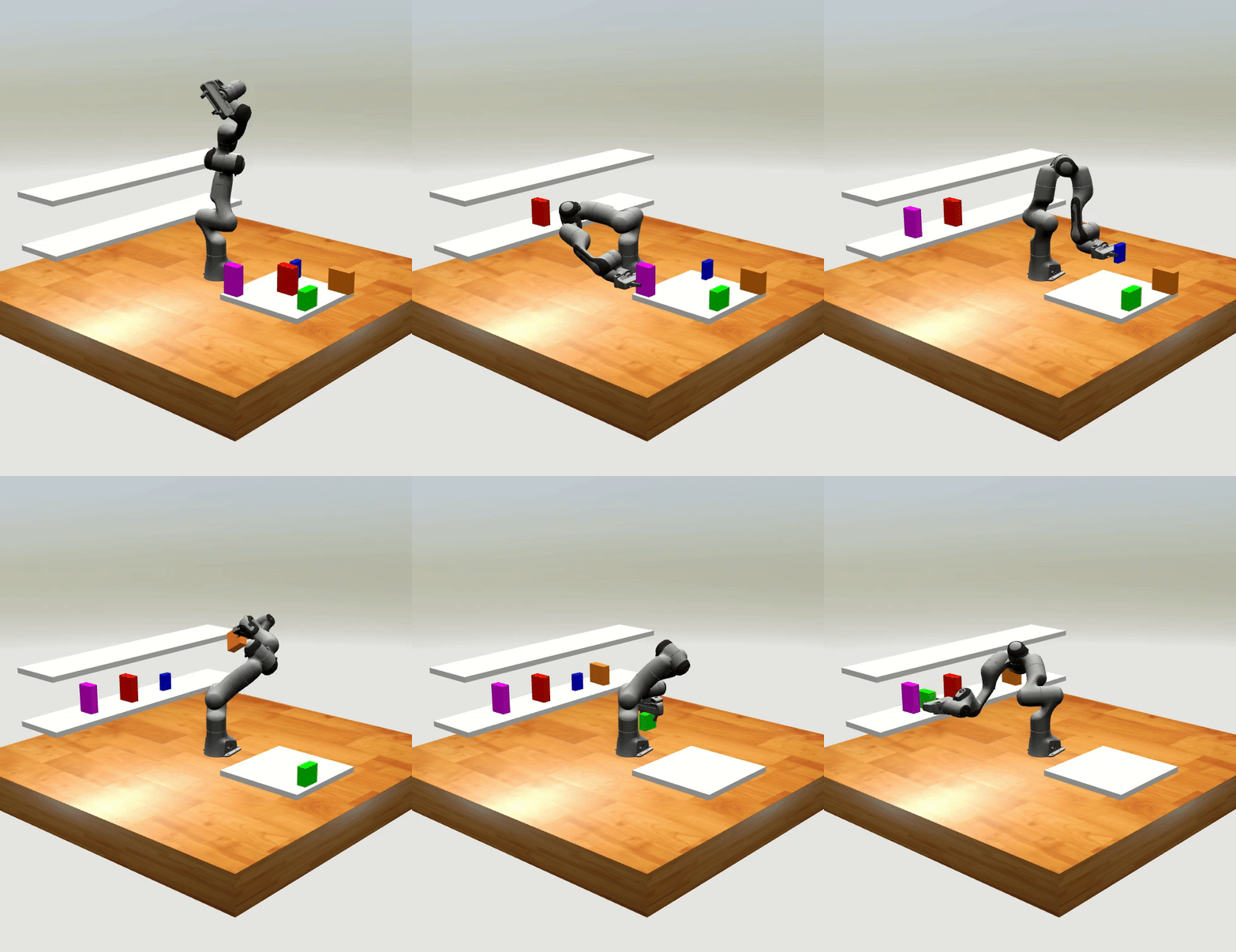
Execution of the unpacking task with 5 objects.
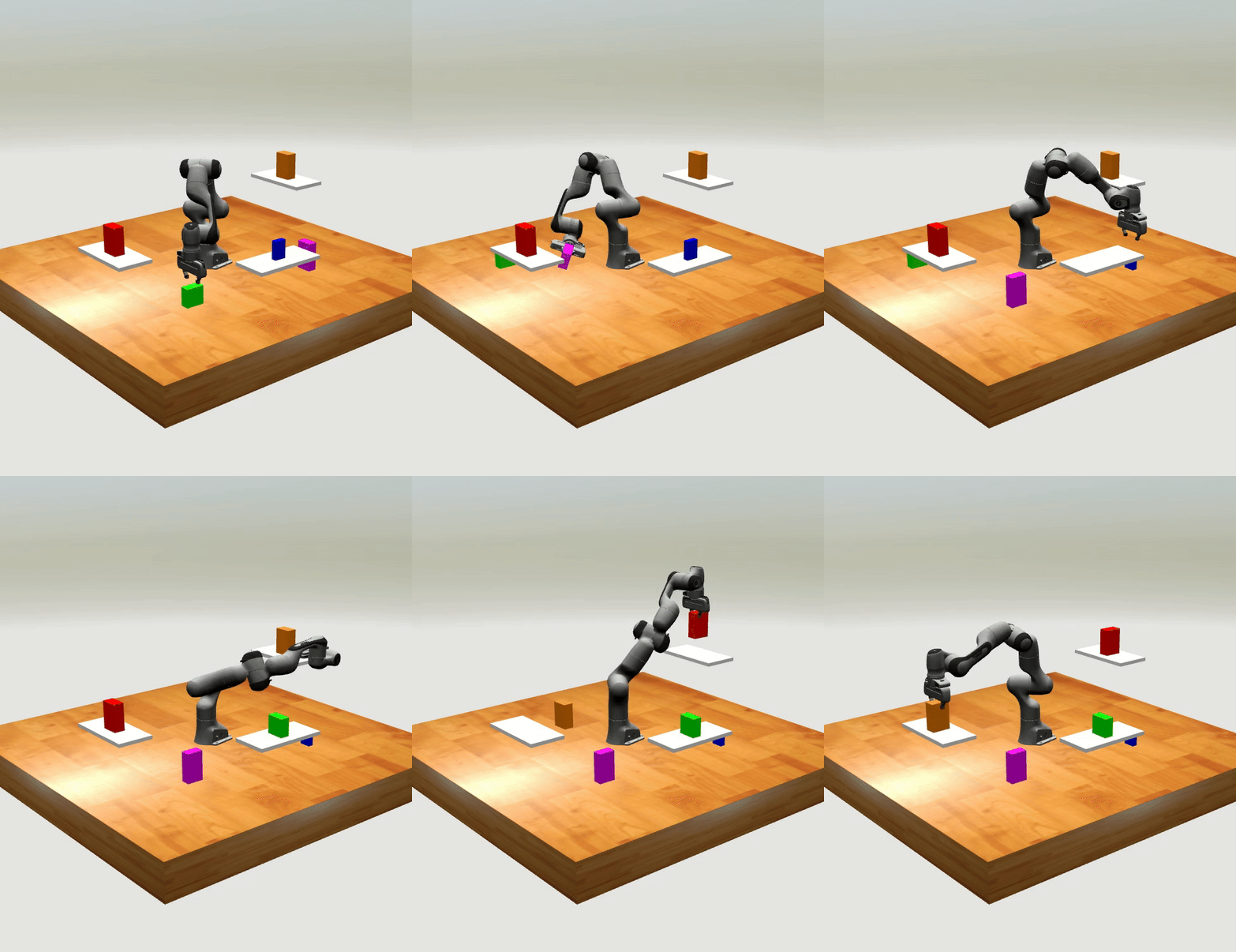
Execution of the swapping task with 5 objects.
BibTeX
            @inproceedings{ait2023learning,
              title={Learning to predict action feasibility for task and motion planning in 3d environments},
              author={Ait Bouhsain, Smail and Alami, Rachid and Simeon, Thierry},
              booktitle={2023 IEEE International Conference on Robotics and Automation (ICRA)},
              pages={3736--3742},
              year={2023},
              organization={IEEE}
            }