Abstract
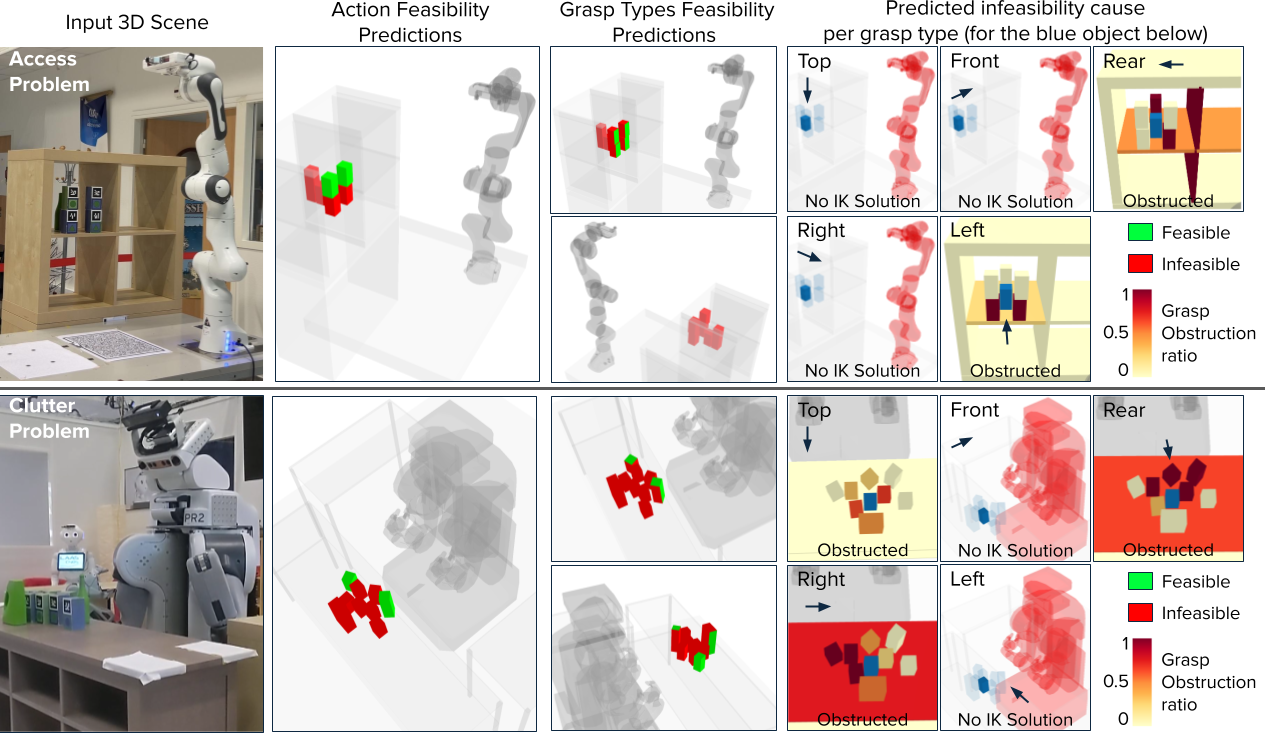
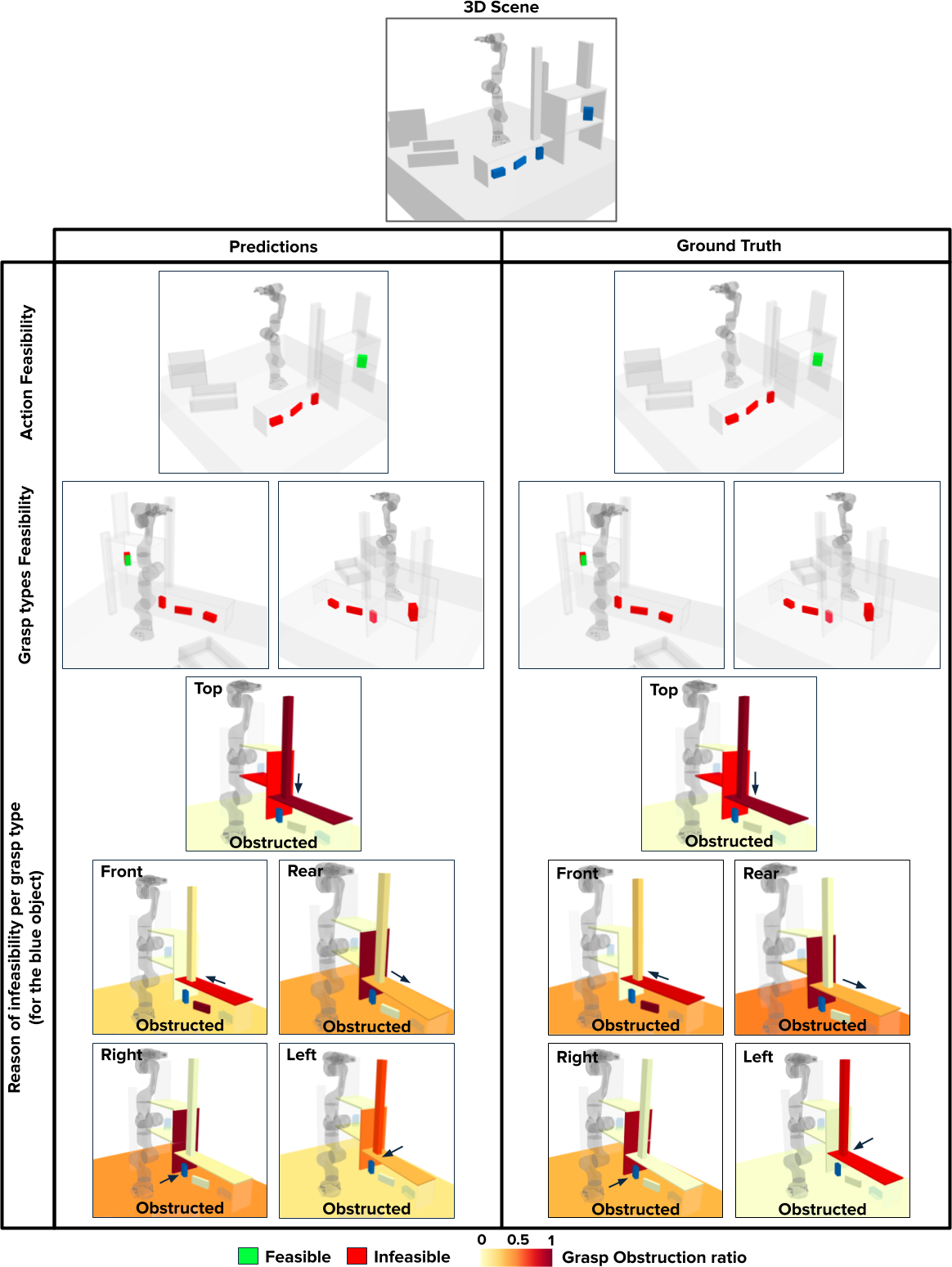
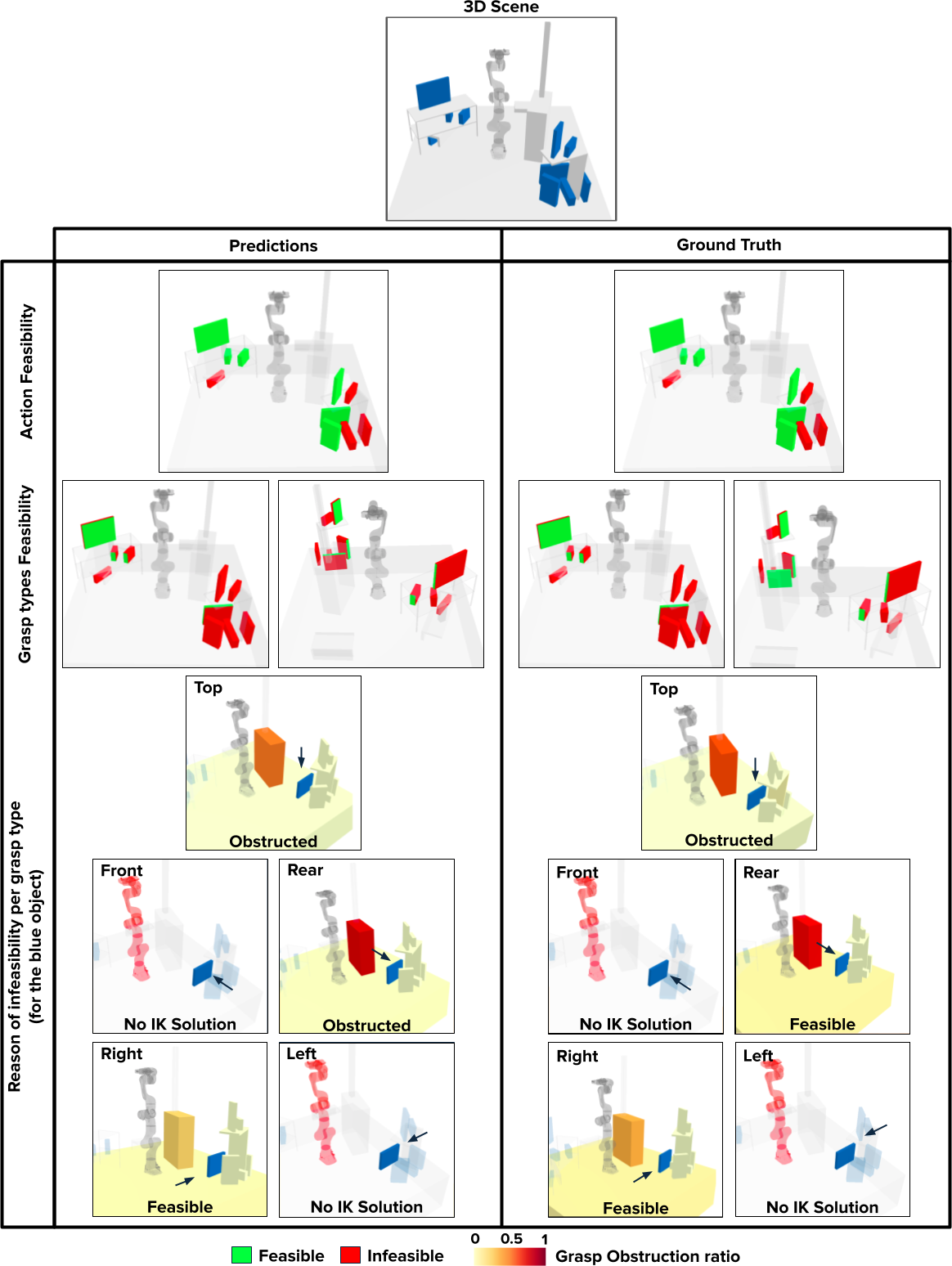
Task and Motion Planning (TAMP) is a computationally challenging robotics problem due to the tight coupling of discrete symbolic planning and continuous geometric planning of robot motions. In particular, planning manipulation tasks in complex 3D environments leads to a large number of costly geometric planner queries to verify the feasibility of considered actions and plan their motions. To address this issue, we propose Geometric Reasoning Networks (GRN), a graph neural network (GNN)-based model for action and grasp feasibility prediction, designed to significantly reduce the dependency on the geometric planner. Moreover, we introduce two key interpretability mechanisms: inverse kinematics (IK) feasibility prediction and grasp obstruction (GO) estimation. These modules not only improve feasibility predictions accuracy, but also explain why certain actions or grasps are infeasible, thus allowing a more efficient search for a feasible solution. Through extensive experimental results, we show that our model outperforms state-of-the-art methods, while maintaining generalizability to more complex environments, diverse object shapes, multi-robot settings, and real-world robots.
Proposed Model
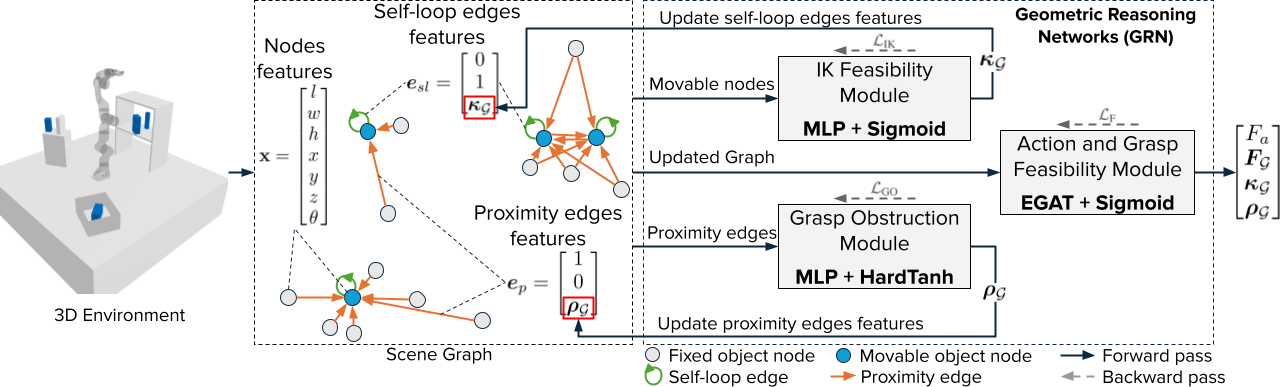
The Geometric Reasoning Networks (GRN) architecture. A scene graph is constructed from the input 3D environment. Node features of movable objects are given to IK feasibility module which outputs are used to update self-loop edge features. The concatenated features of nodes linked through a proximity edge are fed to the GO module to get grasp obstruction estimations, which are appended to proximity edge features. Finally, the updated graph is given to the AGF module to predict the action and grasp types feasibility for each movable object in the environment.
🤗 ModelsDatasets
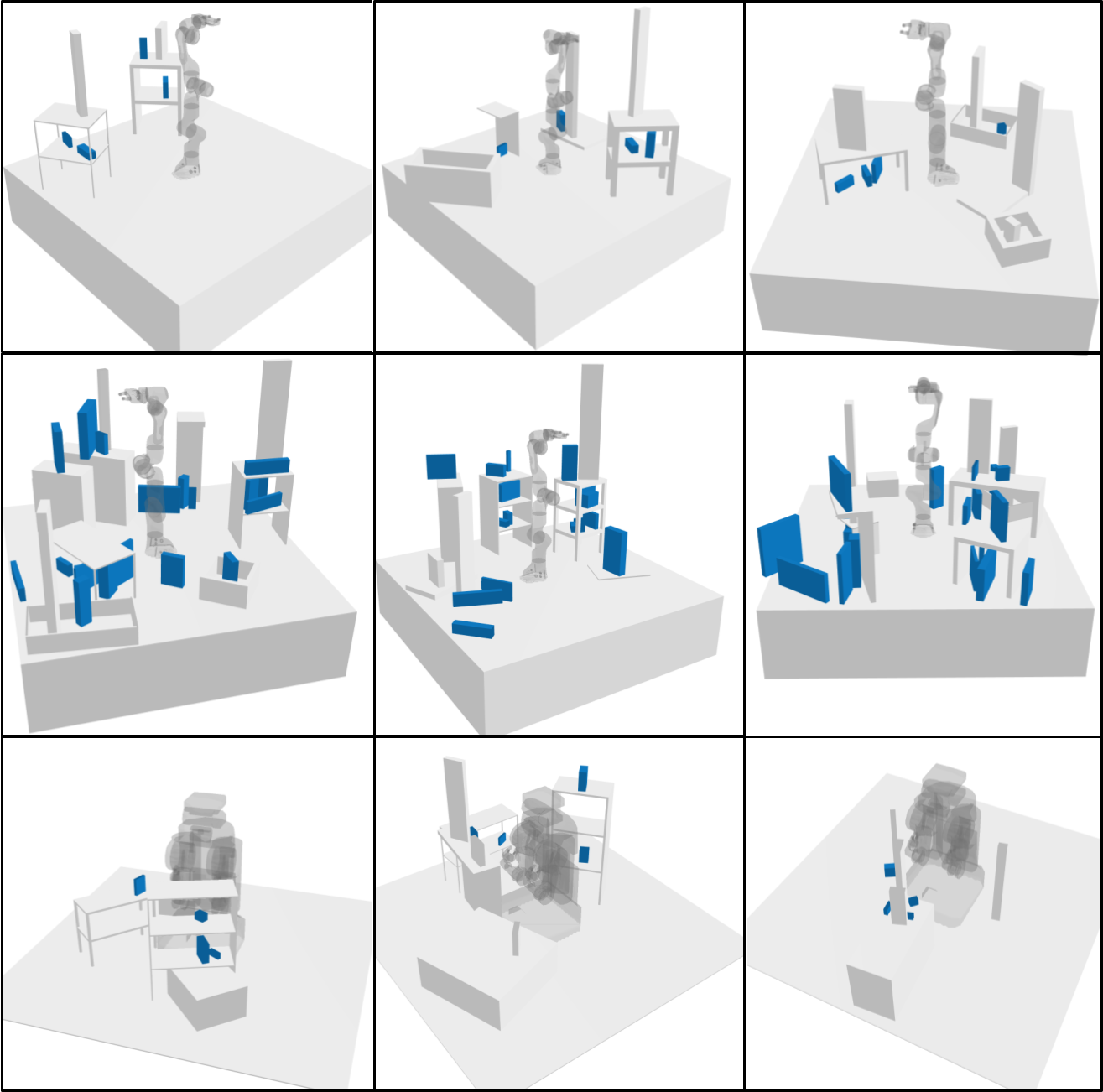
The datasets used for training and evaluation are fully synthetic and generated to simulate diverse 3D environments. Each dataset is characterized by the number of movable objects, structures (e.g., racks, counters, baskets), obstacles, and the robot used for annotation. For instance, the Panda-3D-4 dataset includes 3D environments with 4 movable objects, up to 4 structures, and up to 4 obstacles, annotated using a Panda robot. Similarly, the Panda-Tabletop-4 dataset focuses on tabletop environments with 4 movable objects and up to 4 obstacles, designed for comparison with tabletop methods. The PR2-3D-4 dataset demonstrates applicability to the PR2 robot, using parameters similar to Panda-3D-4. Additional test sets, such as Panda-3D-10, Panda-3D-15, and Panda-3D-20, evaluate generalizability to environments with higher object counts and increased complexity.
🤗 DatasetsResults
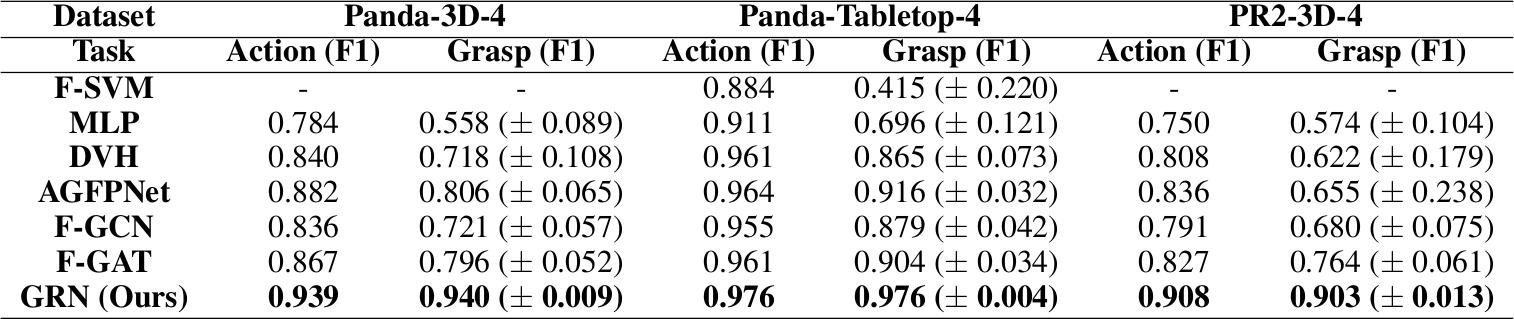
Comparison with SOTA methods trained and tested on different datasets. For grasp types feasibility prediction, the mean (+/- standard deviation) of F1 scores of the 5 grasp types are reported.

Evaluation of the generalizability to 3D environments with a higher number of objects compared to SOTA methods, when trained on the Panda-3D-4 dataset.
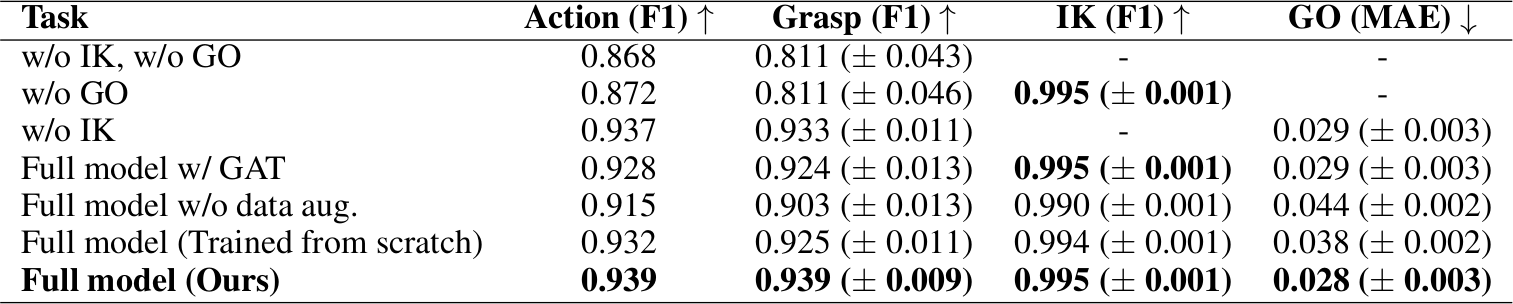
Ablation Study on the Panda-3D-4 dataset. For each task related to grasp types, we report the mean ($\pm$ standard deviation) across all grasp types.
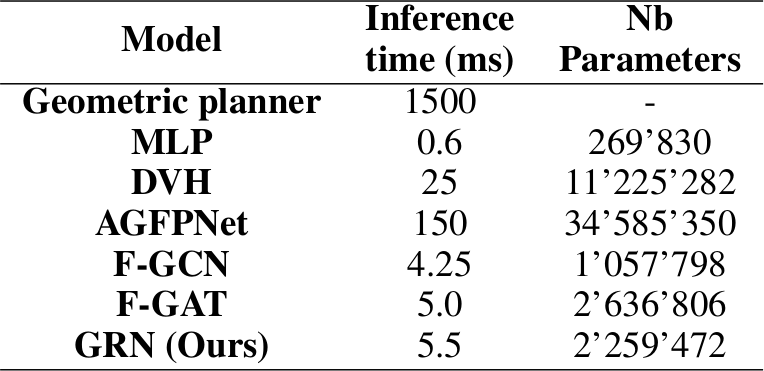
Comparison of the number of parameters and inference time on a 3D environment with 4 movable objects and 15 fixed objects (4 queries).
Visualizations
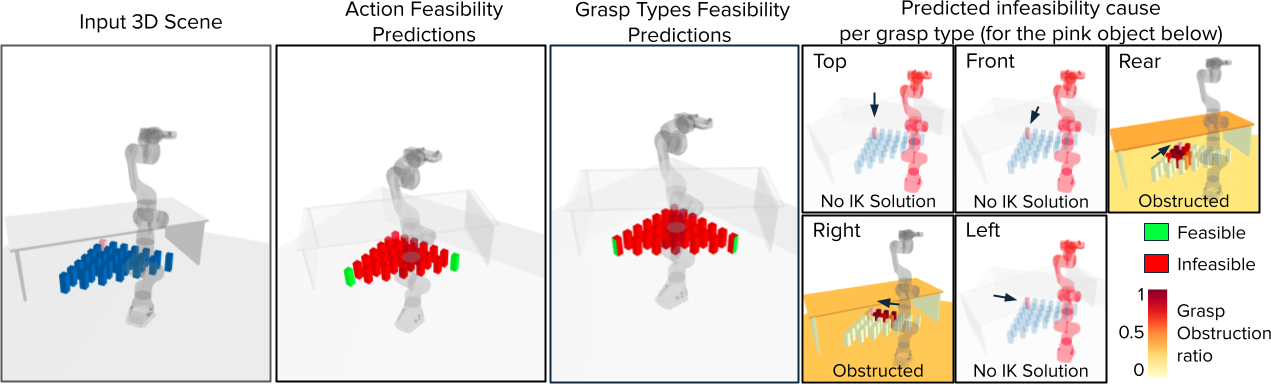
Visualization of GRN predictions on the initial state of a larger version of the Access problem. The goal is to have the robot grasp the pink object, which is initially blocked by many objects.
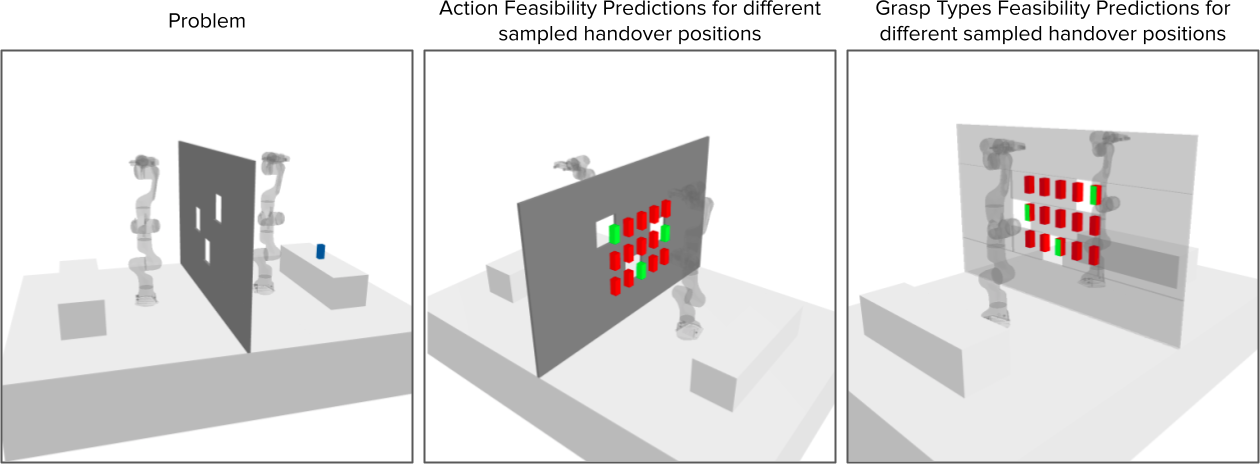
Visualization of GRN predictions on the initial state of the Handover problem. The goal is to perform a handover through a wall, with only three openings available for passing the object.
Application to TAMP Problems
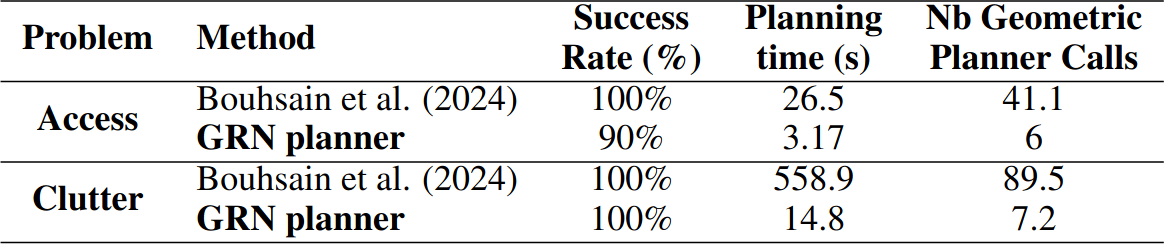
Performance of GRN planner compared to a non-informed planner on the Access and Clutter problems. Results are average over 10 runs on 10 different instances of each problem.
Access Problem
Clutter Problem
BibTeX
            @inproceedings{ait2025learning,
              title={Learning Geometric Reasoning Networks for Robot Task and Motion Planning},
              author={Ait Bouhsain, Smail and Alami, Rachid and Simeon, Thierry},
              booktitle={The Thirteenth International Conference on Learning Representations (ICLR 2025)},
              year={2025}
            }