Abstract
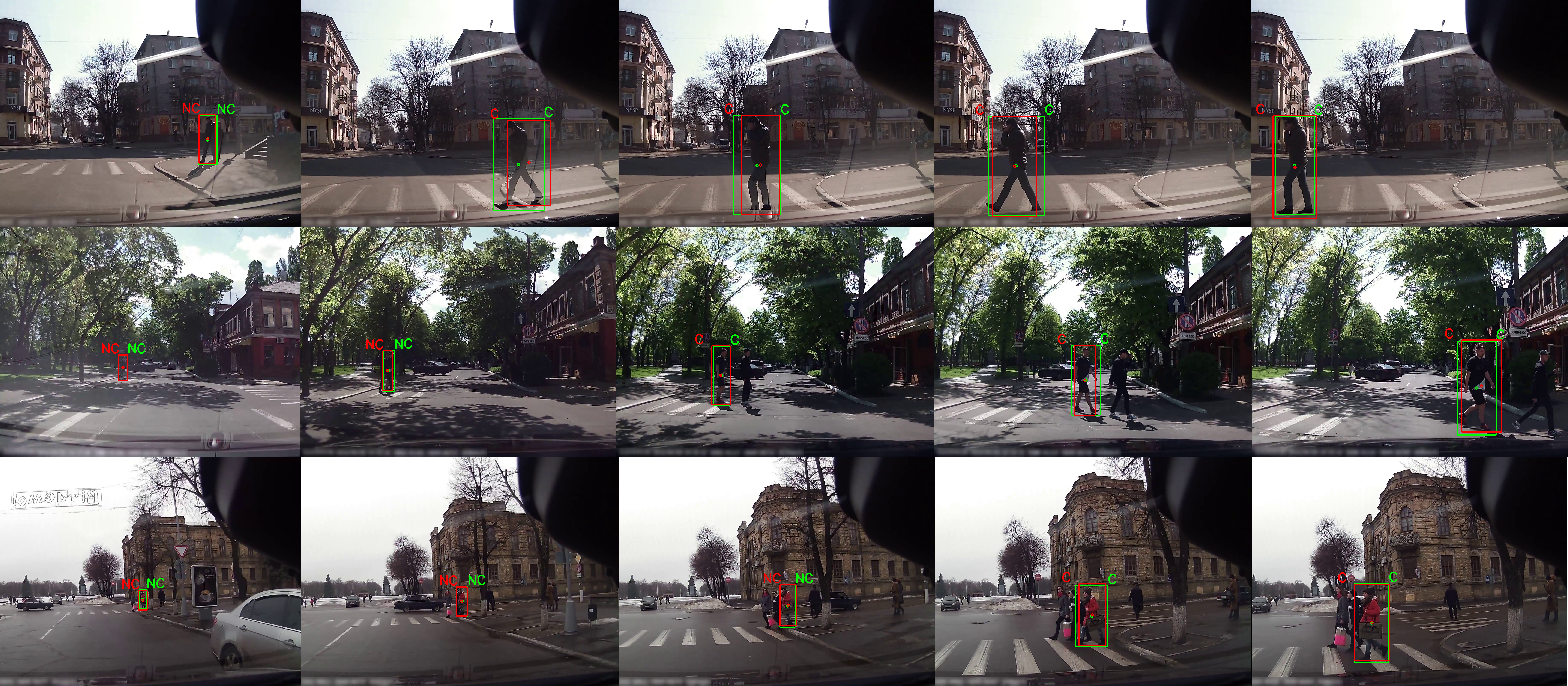
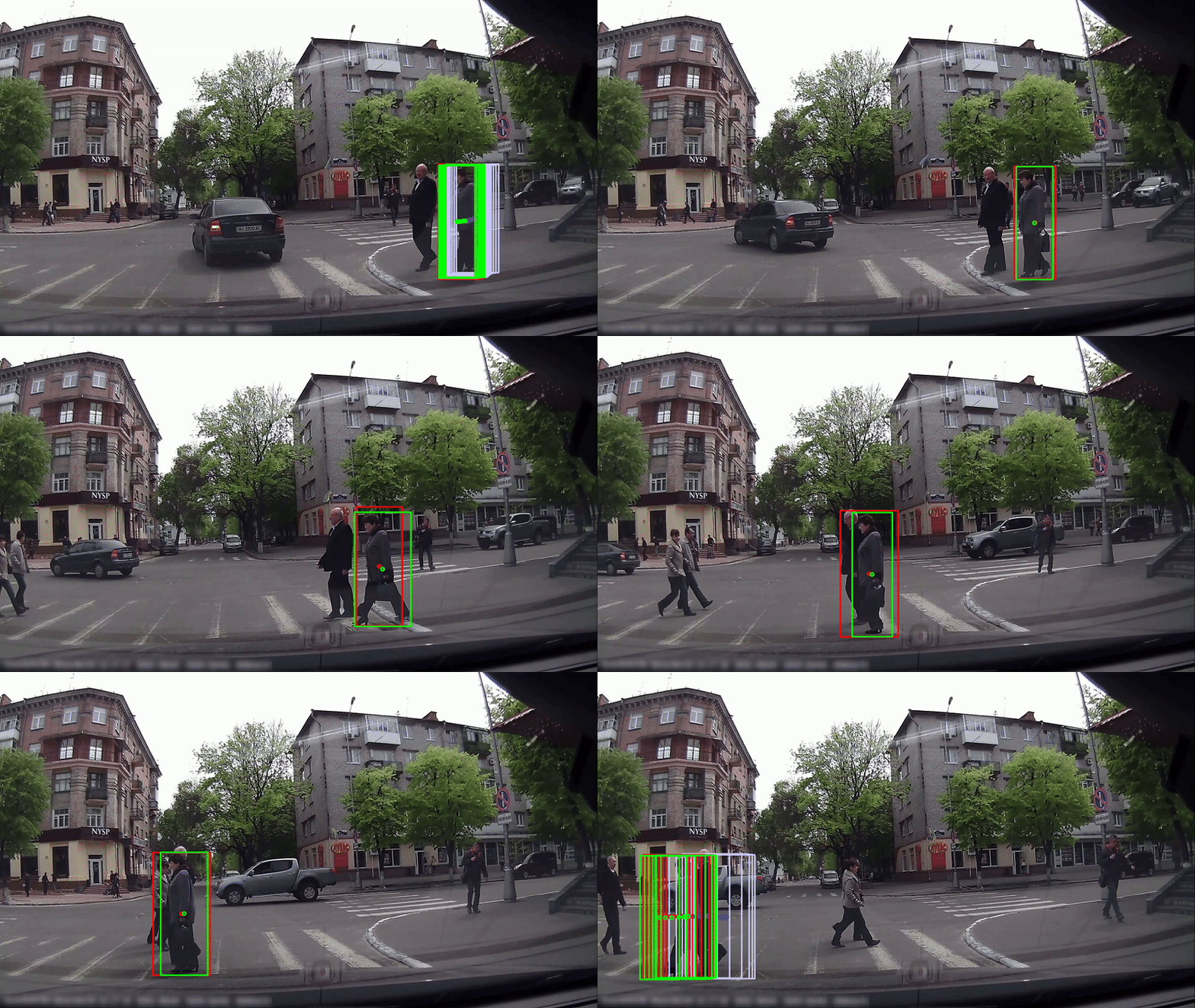
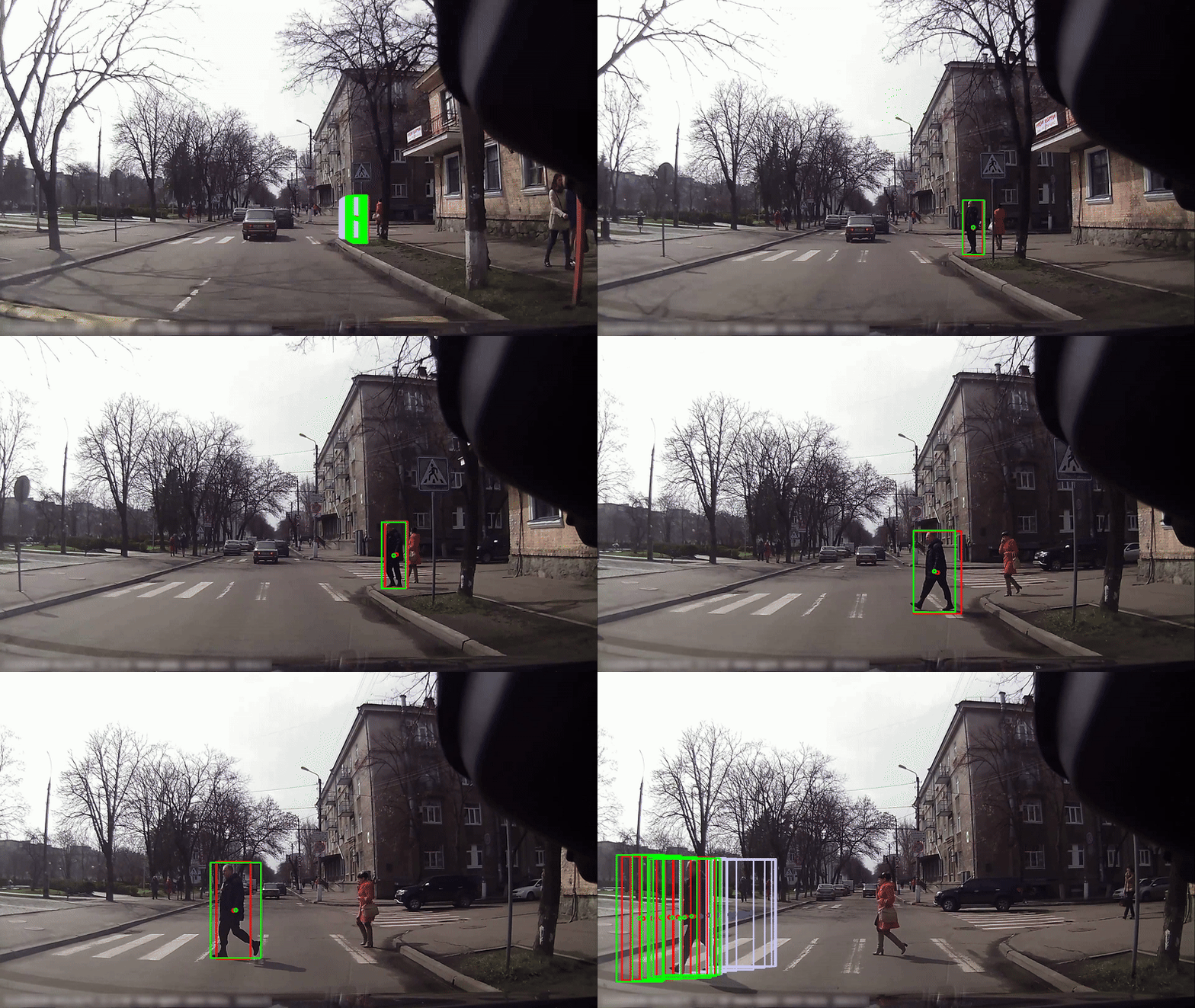
In order to be globally deployed, autonomous cars must guarantee the safety of pedestrians. This is the reason why forecasting pedestrians' intentions sufficiently in advance is one of the most critical and challenging tasks for autonomous vehicles. This work tries to solve this problem by jointly predicting the intention and visual states of pedestrians. In terms of visual states, whereas previous work focused on x-y coordinates, we will also predict the size and indeed the whole bounding box of the pedestrian. The method is a recurrent neural network in a multi-task learning approach. It has one head that predicts the intention of the pedestrian for each one of its future position and another one predicting the visual states of the pedestrian. Experiments on the JAAD dataset show the superiority of the performance of our method compared to previous works for intention prediction. Also, although its simple architecture (more than 2 times faster), the performance of the bounding box prediction is comparable to the ones yielded by much more complex architectures.
Proposed Model
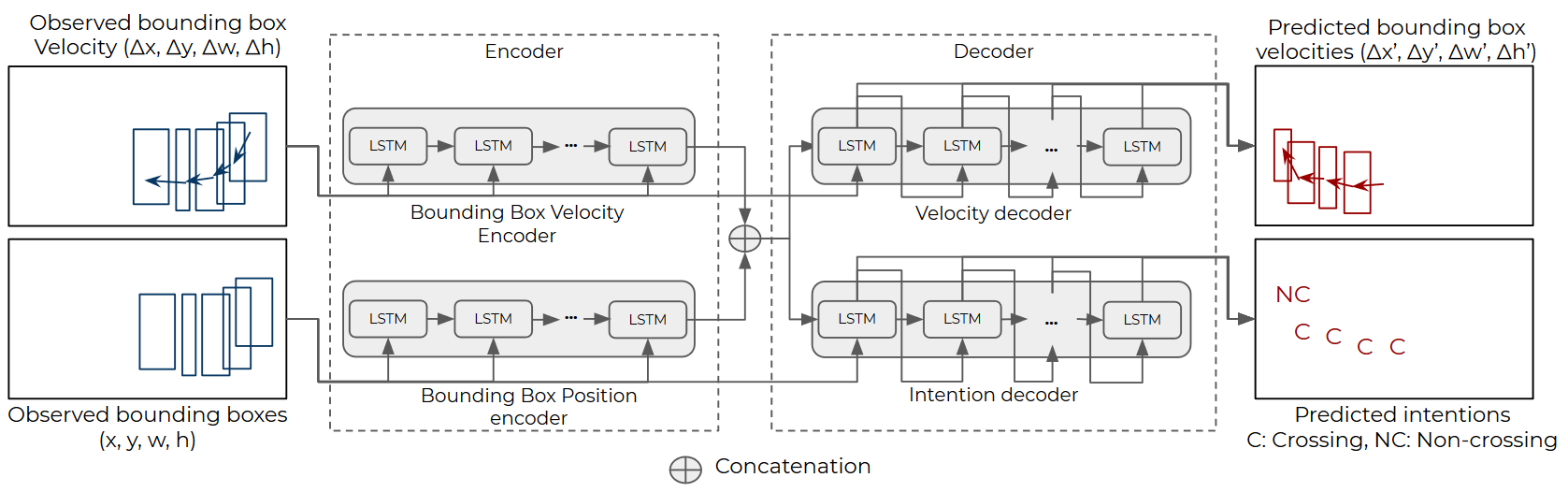
The proposed multi-task learning network is an LSTM based encoder-decoder architecture that leverages the position and dimensions of the observed bounding box as well as their velocity in order to predict the future bounding boxes of pedestrians as well as a sequence of future intentions.
Visualizations


BibTeX
            @article{ait2020pedestrian,
              title={Pedestrian intention prediction: A multi-task perspective},
              author={Ait Bouhsain, Smail and Saadatnejad, Saeed and Alahi, Alexandre},
              journal={9th Symposium of the European Association for Research in Transportation (hEART 2020)},
              year={2020}
            }