Abstract
In this paper, we address task and motion plan-ning (TAMP) which is an important yet challenging robotics problem. It is known to suffer from the high combinatorial complexity of discrete search, often requiring a large number of geometric planning calls. We build upon recent works in TAMP by taking advantage of learning methods to provide action feasibility information as a heuristic to the symbolic planner, thus guiding it to a geometrically feasible solution and reducing geometric planning time. We propose AGFP-Net, a multi-task neural network predicting not only action feasibility, but also the feasibility of a set of grasp types. We also propose an improved feasibility-informed TAMP algorithm capable of solving more complex problems, and handling goals which are not fully specified. Comparative results obtained on different problems of varying complexity show that our method is able to greatly reduce task and motion planning time.
Proposed Model

A visualization of the proposed neural network architecture used for action and grasp feasibility prediction.
Benchmarks
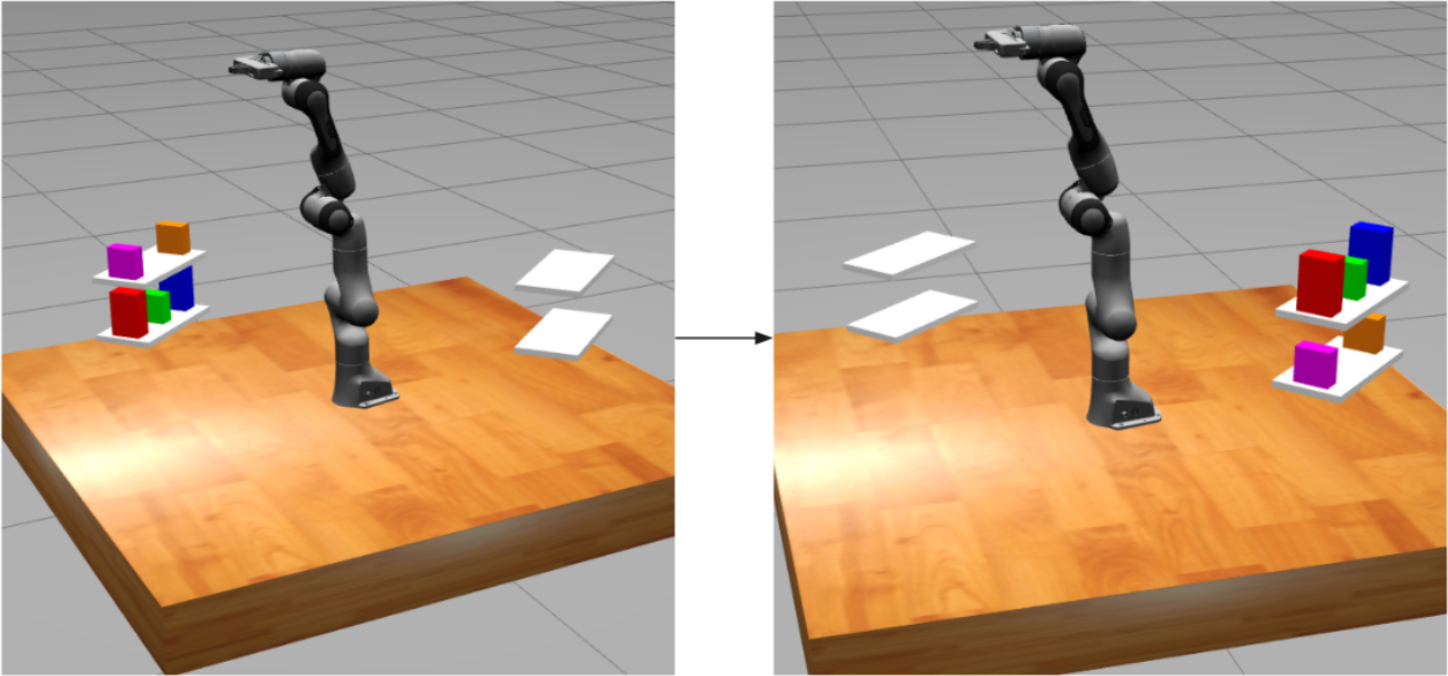
Reorder problem: Objects initially placed on a two-shelf cupboard must be moved to another cupboard in a different order, testing the algorithm's ability to handle grasp choices and infeasible placements under shelves.
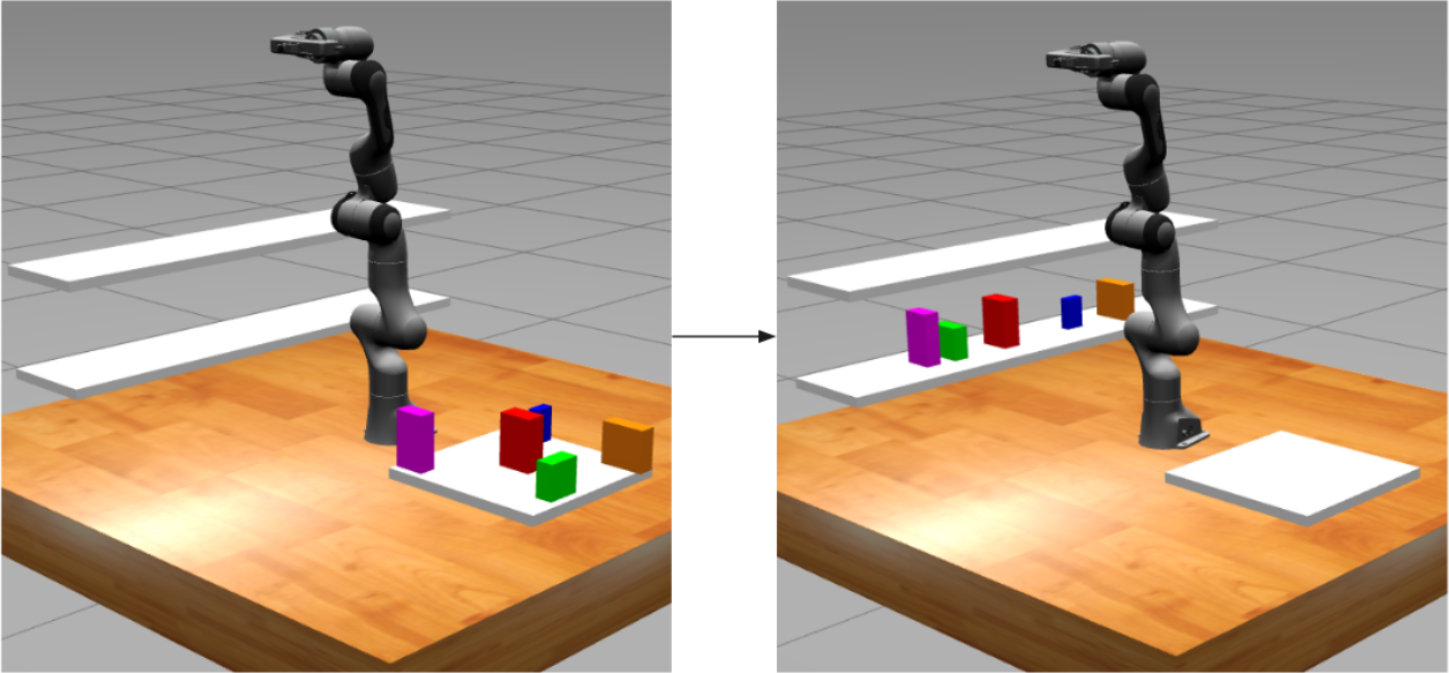
Unpack problem: Objects initially placed on a tray-like surface must be unpacked and ordered into a cupboard. The challenge lies in selecting feasible grasps due to the proximity of objects and the restricted goal placements under a shelf, which disallow top grasps.
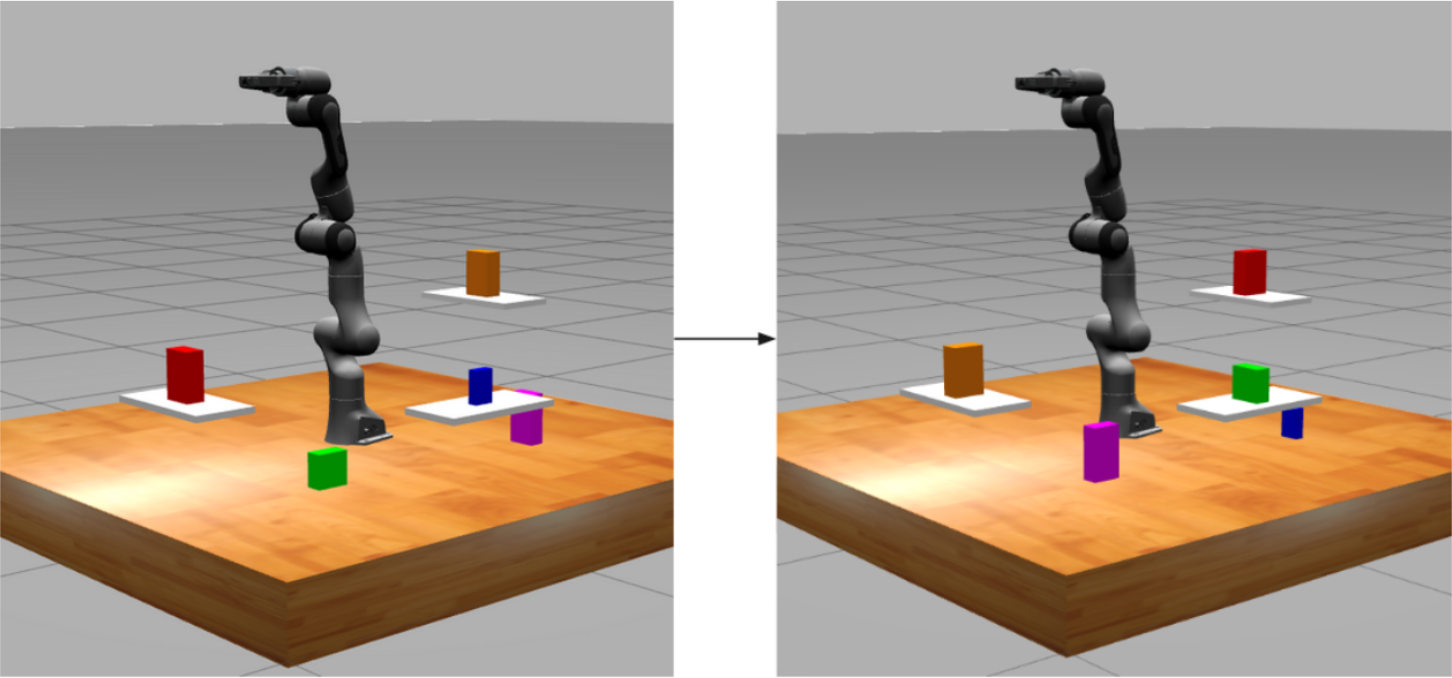
Swap problem: A set of objects are initially placed either on the table or on higher support surfaces, and the goal is to swap their poses. The challenge arises from the fact that the goal poses of objects are already occupied, requiring the use of intermediary placements to achieve the desired configuration.
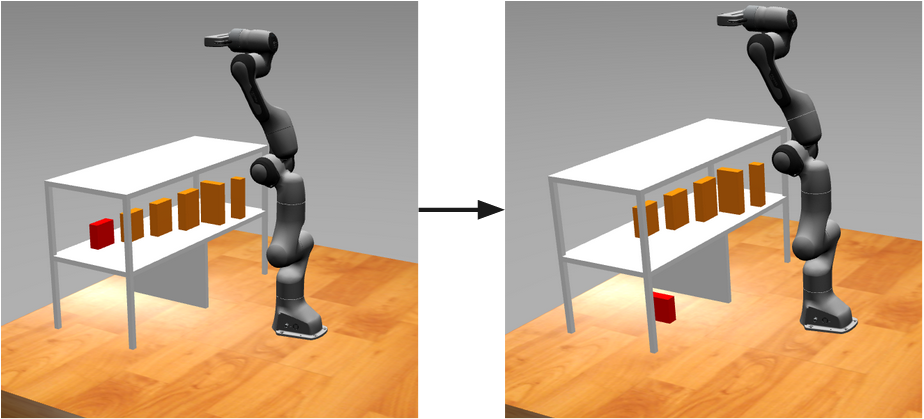
Access problem: The task involves moving a single object (red) to its goal placement while ensuring all other objects are returned to their initial positions. The challenge arises as each object blocks access to the next, requiring the robot to sequentially move blocking objects to temporary placements, position the red object, and then restore the moved objects in their original order.
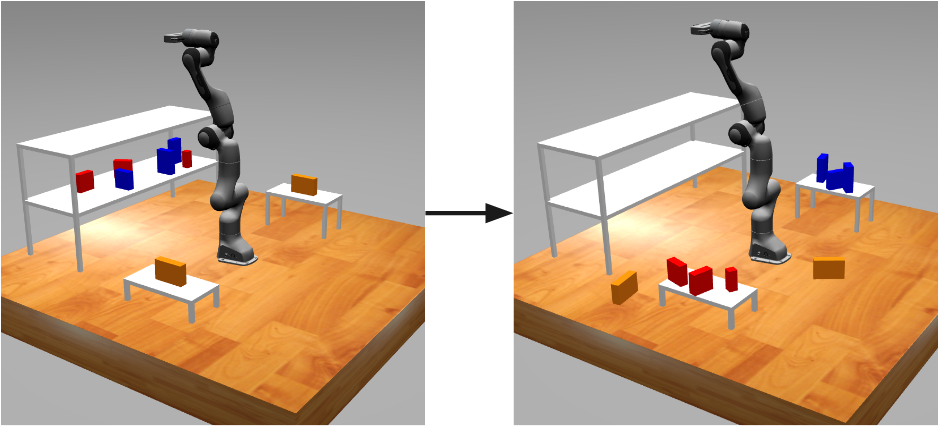
Sort problem: The task involves moving a set of objects from a shelf to one of two small tables based on their color. The challenge lies in placement sampling, as the planner must find feasible placements that allow all objects of the same color to fit on narrow surfaces. Additionally, the initial proximity of objects requires a specific order of movement. The problem is further complicated by the presence of blocking objects (orange) with unspecified goals on the tables.
Results
Detailed planning times of our algorithm on the Reorder, Unpack and Swap problems with and without feasibility prediction, compared to our previous work, averaged over 10 runs.
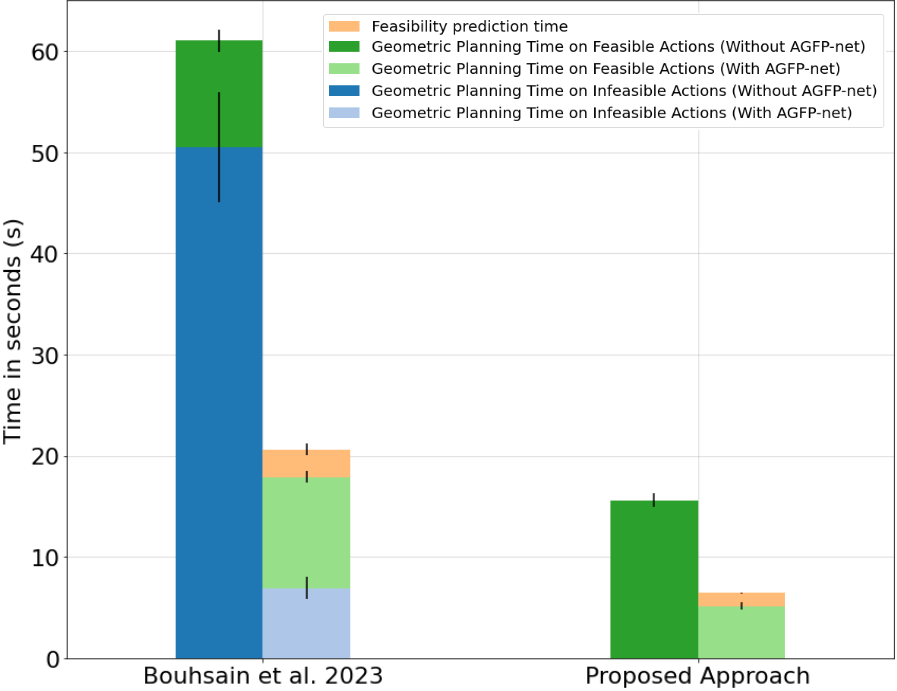
Reorder Problem
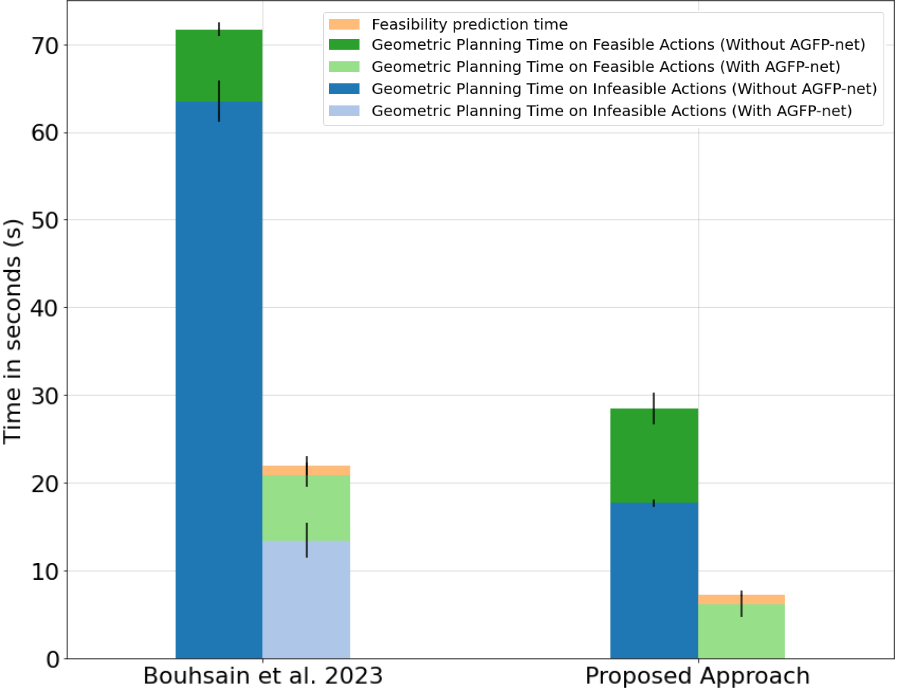
Unpack Problem
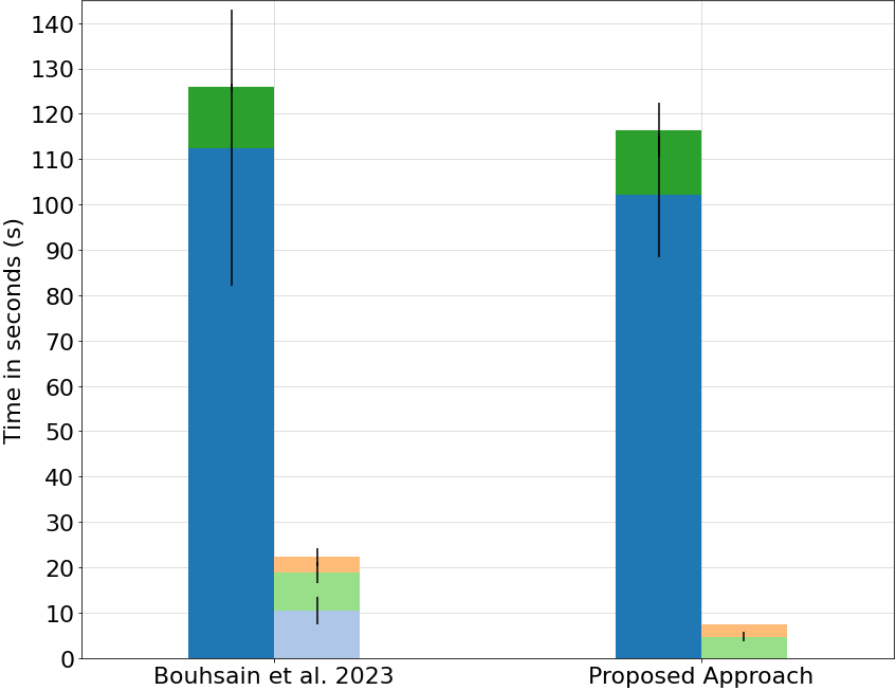
Swap Problem
Detailed planning times of our algorithm on the Access and Sort problems with and without AFP-Net, averaged over 10 runs.
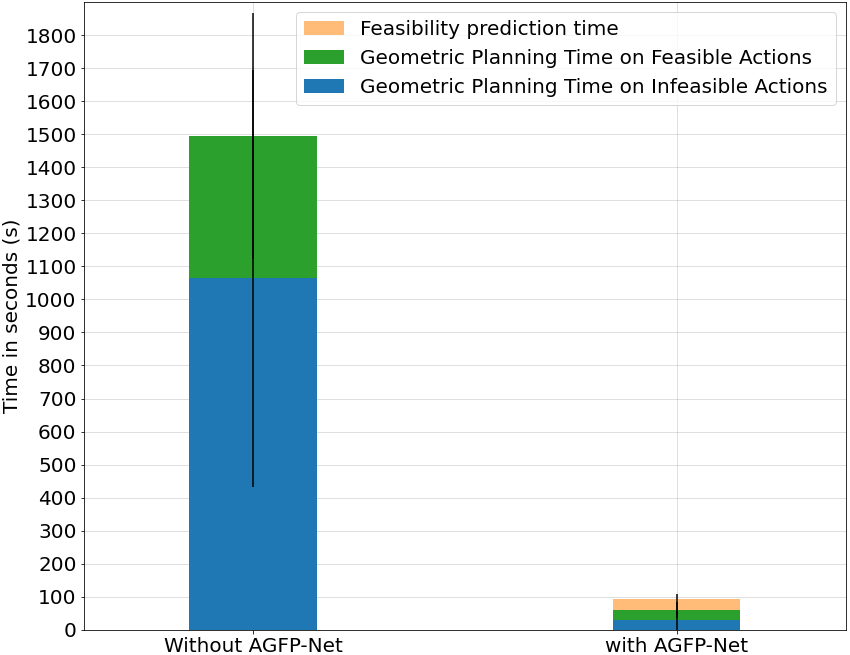
Access Problem
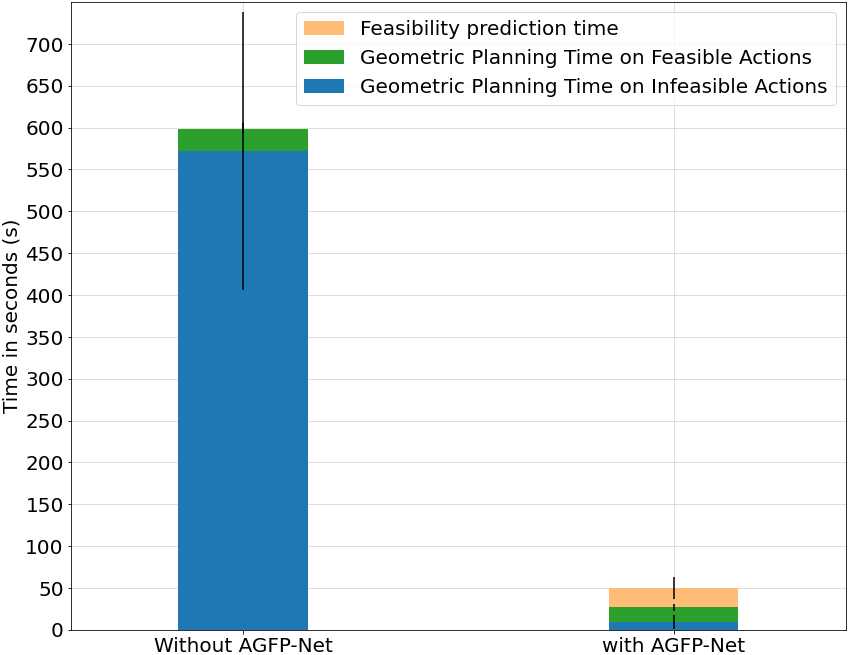
Sort Problem
Visualizations
Plan execution visualizations for each problem.
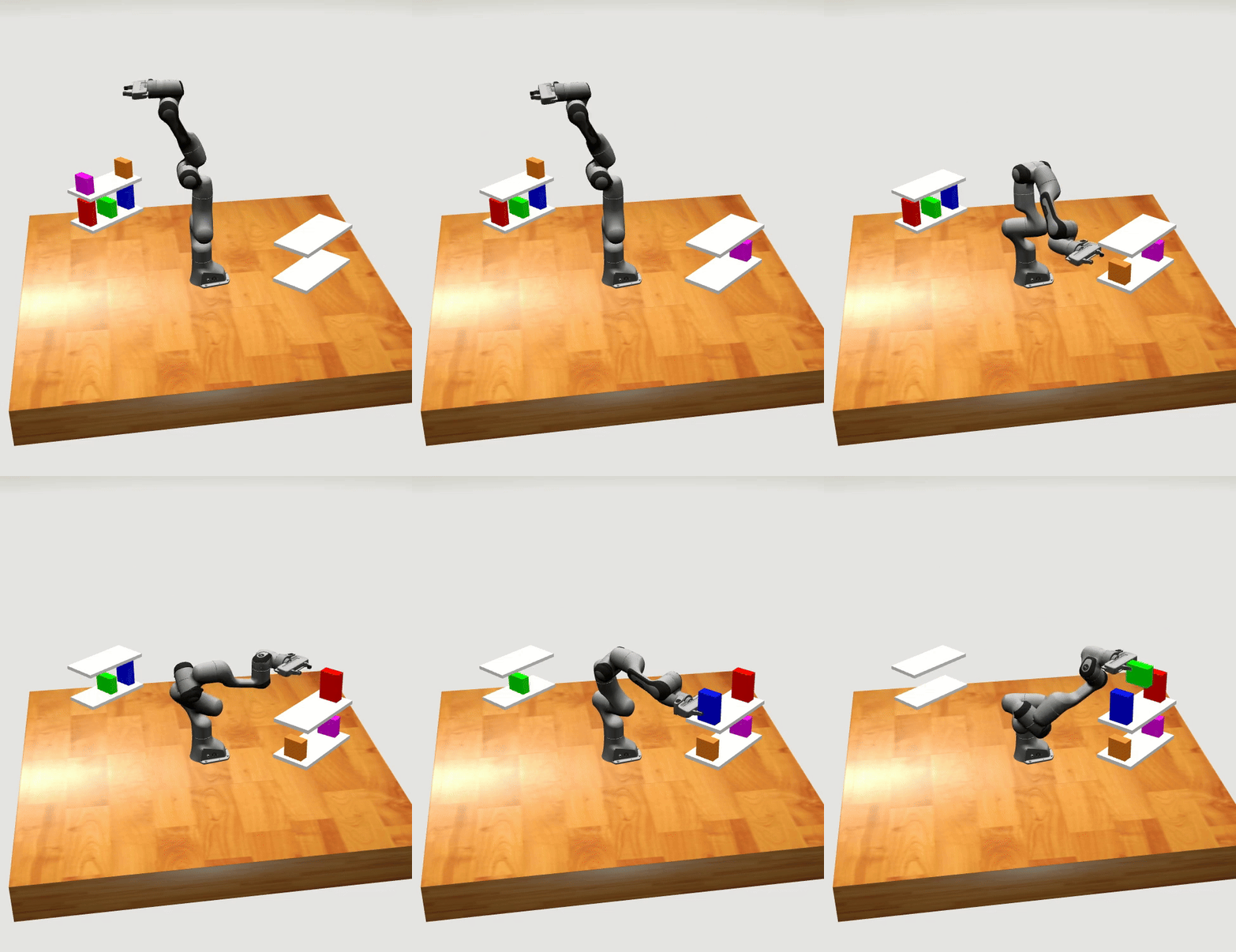
Reorder Problem
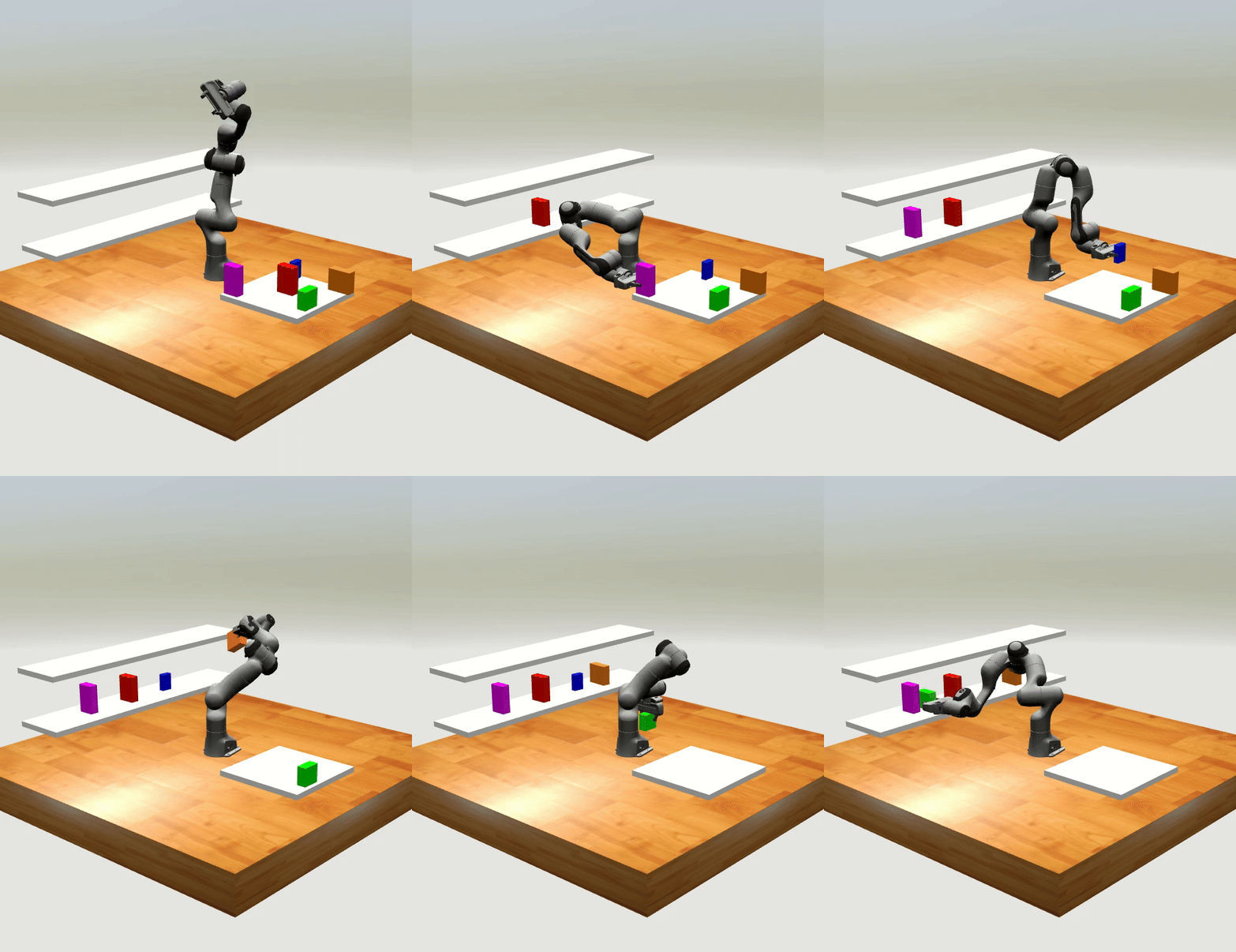
Unpack Problem
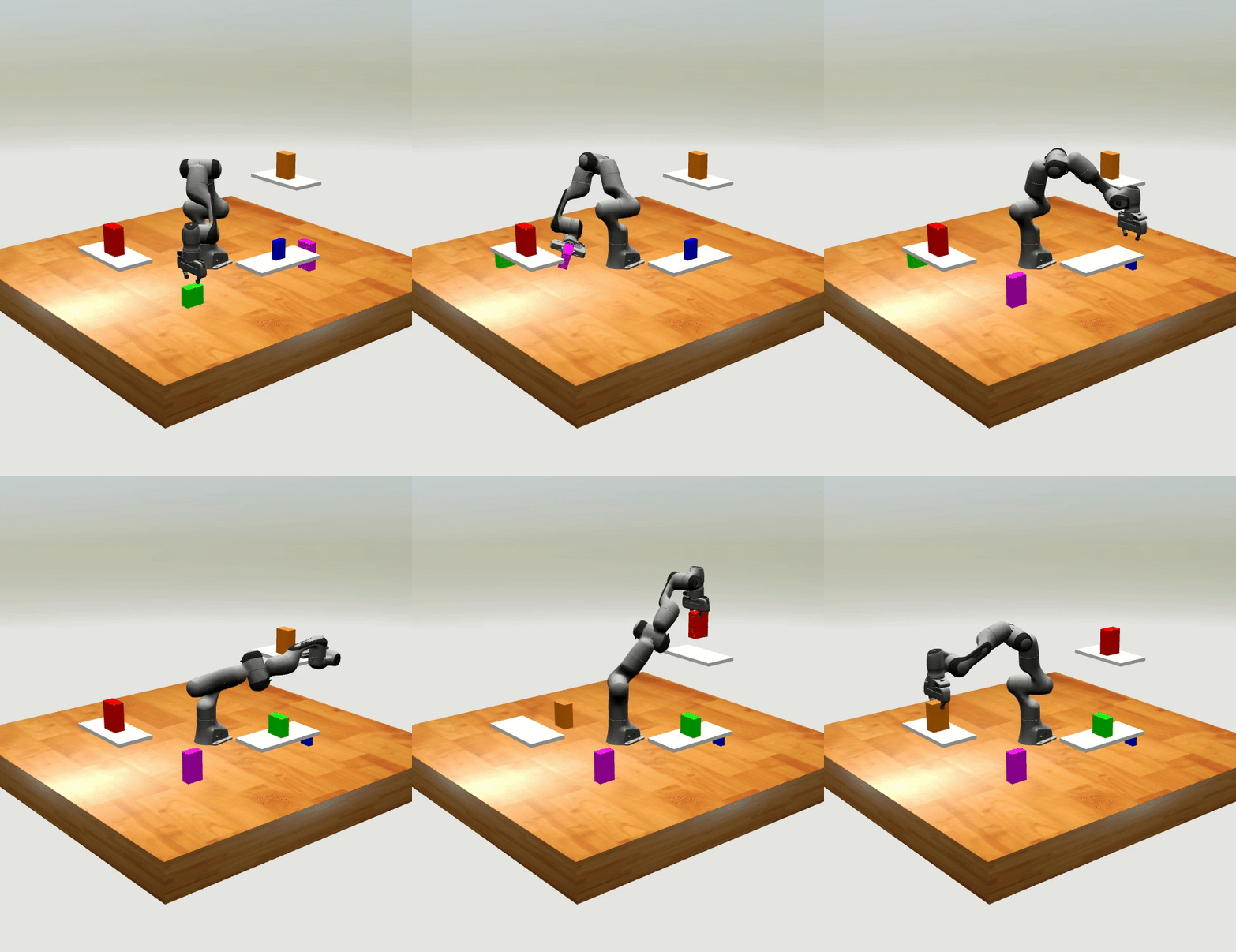
Swap Problem
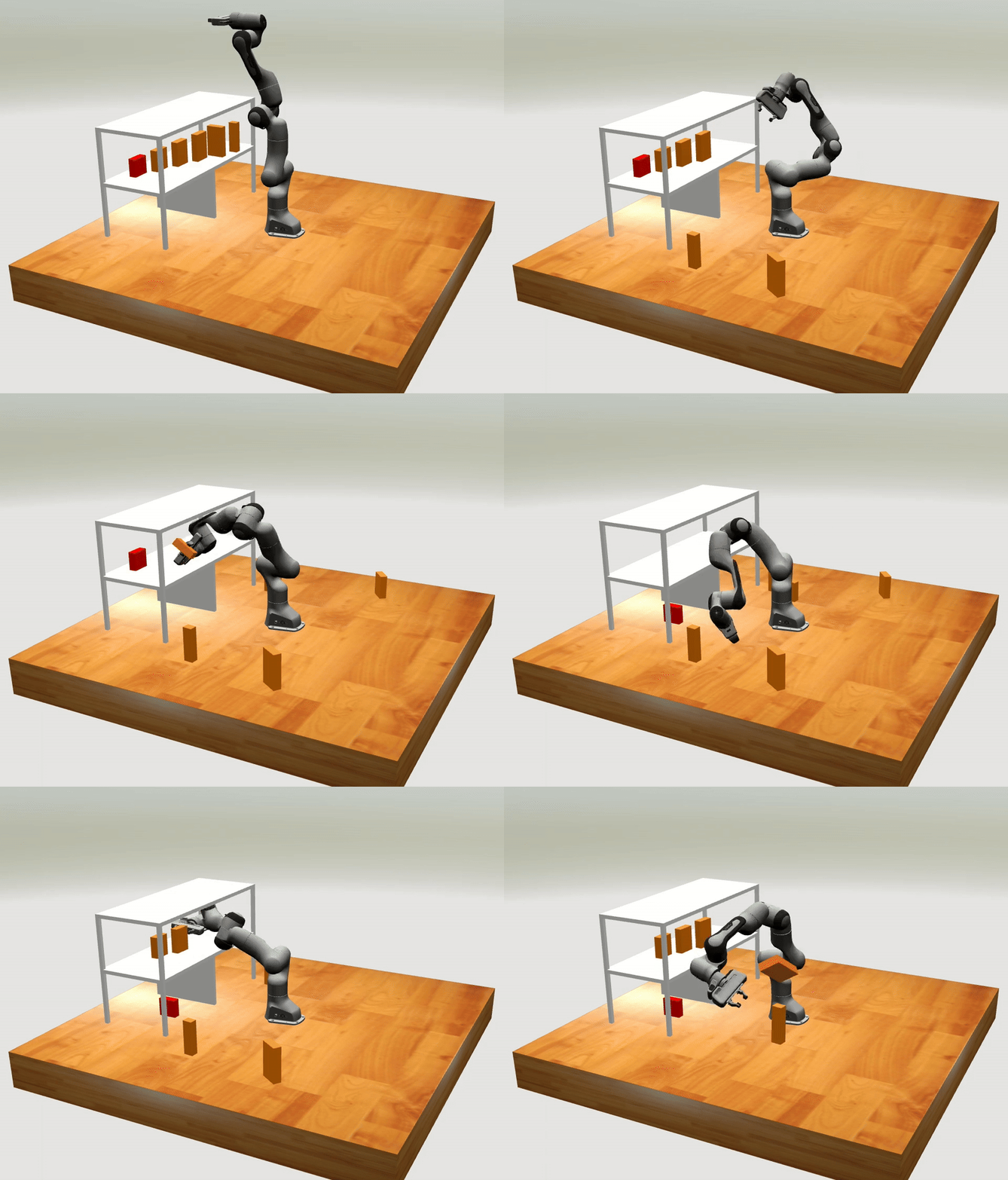
Access Problem
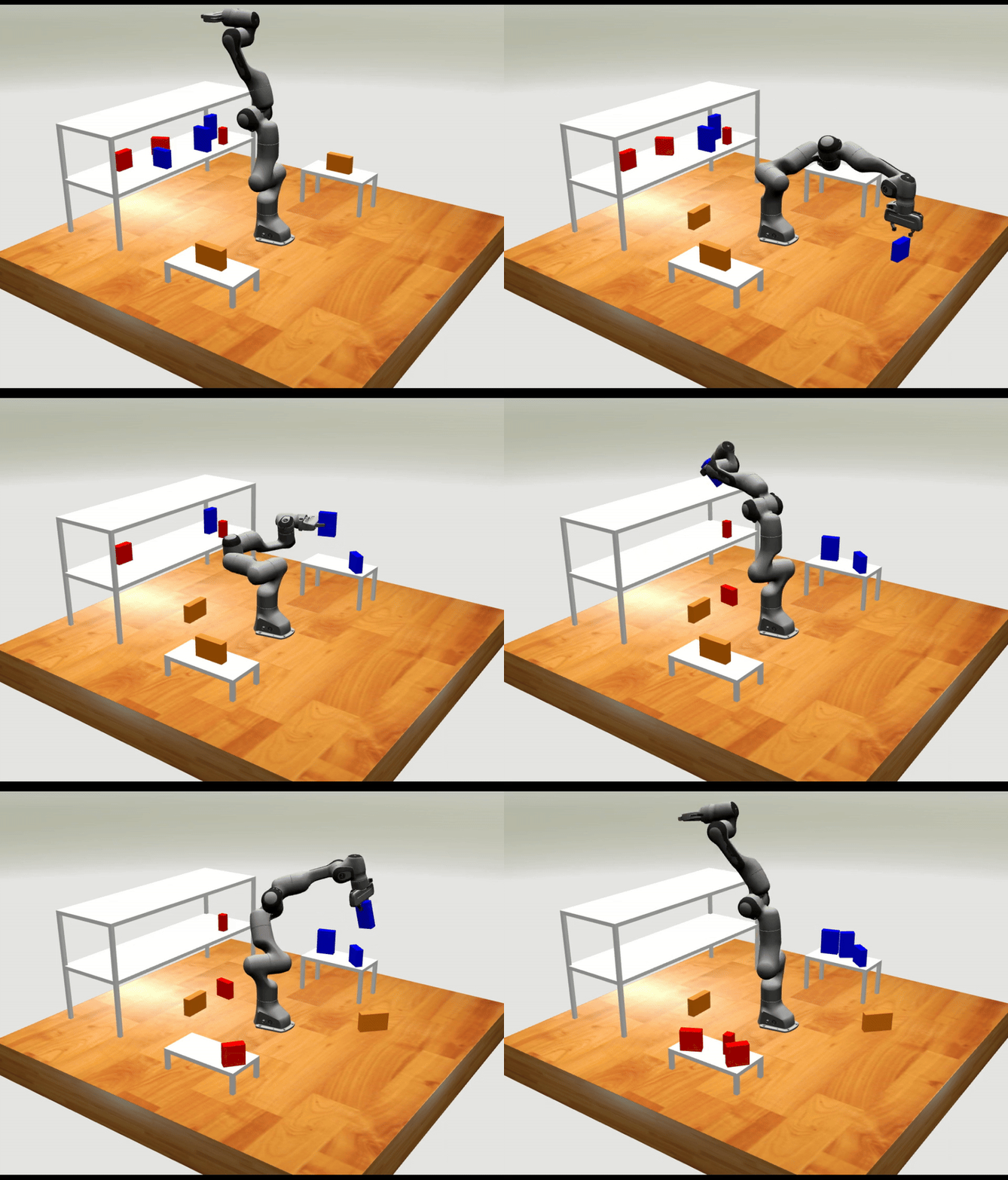
Sort Problem
BibTeX
            @inproceedings{ait2023simultaneous,
              title={Simultaneous action and grasp feasibility prediction for task and motion planning through multi-task learning},
              author={Ait Bouhsain, Smail and Alami, Rachid and Simeon, Thierry},
              booktitle={2023 IEEE/RSJ International Conference on Intelligent Robots and Systems (IROS)},
              pages={2042--2048},
              year={2023},
              organization={IEEE}
            }